Thursday, May 31, 2007

How low can you go

Check this out

w w w . h a a r e t z . c o m

--------------------------------------------------------------------------------


Last update - 18:50 30/05/2007

Sheetrit, Eitan propose firing 'Israeli Qassam' at Gaza Strip
By Aluf Benn, Haaretz Correspondent, Haaretz Staff and Agencies


Ministers Meir Sheetrit and Rafi Eitan proposed Wednesday that Israel produce its own version of the Qassam rocket to be fired at targets inside the Gaza Strip in response to Palestinian rocket fire on its southern communities.

The suggestion was made at a meeting of the security cabinet to discuss the ongoing military operation aimed at countering Qassam fire from Gaza.

The two said that this kind of rocket, which would cost very little, would cause a small amount of damage but would put pressure on the population in Gaza.

The cabinet decided at the meeting to reject a cease-fire with Hamas over the violence in the Gaza Strip, and that the Israel Defense Forces should continue with its ongoing policy of military action against the Palestinian militant groups.

Minister of Industry, Trade and Labor Eli Yishai of Shas proposed that Israel use air strikes to destroy Palestinian towns and villages in response to the rocket fire, after giving local residents advance notice allowing them to evacuate their homes.

Strategic Affairs Minister Avigdor Lieberman also suggested intensifying Israel's response to the Qassams, but Prime Minister Ehud Olmert rejected both proposals.

Shas MK Yitzhak Cohen proposed cutting off the supply of electricity, water and fuel to the Strip, and justify the move by saying that Qassam rockets had destroyed Israel's infrastructure and that it will take a long time to repair the facilities with which to supply the Palestinians with basic resources. Shin Bet security service director Yuval Diskin suggested that Cohen's idea is worth examining.

Noting a "relative decrease in Qassam rocket launchings," the cabinet decided to continue "attacks and military pressure on terrorist groups, mainly Hamas and Islamic Jihad," Olmert's office said in a statement.

"It was emphasized [at the meeting] that Israel is not conducting any negotiations for a cease-fire with the terrorist organizations," the statement said.

The methods currently employed by the IDF include air strikes on those responsible for or carrying out Qassam rocket attacks on southern Israel, limited ground operations within the Gaza Strip, and targeted assassinations of those firing rockets and members of the military wings of Hamas and Islamic Jihad.

Meanwhile, Hamas political leader Khaled Meshal said in an interview published Wednesday that the organization intends to continue its attacks on Israel despite the IDF operations in Gaza.

A political source in Jerusalem said Tuesday, however, that Hamas is under increased pressure due to the number of casualties in the Strip and the number of arrests in the West Bank.

According to the source, Hamas and Islamic Jihad are experiencing difficulties in firing rockets, due to Israeli pressure, which is evidenced by a reduction in the number of launches.

The source added that the original Palestinian cease-fire offer was not acceptable to Israel, and that "we must see what they offer in the future."

A Qassam rocket directly hit the fourth floor of a building in Sderot on Wednesday. The strike caused damage to several apartments in the building. No one was wounded but several people were treated for shock.

Security sources told Haaretz that the leaders of Hamas' military wing disagreed on Tuesday as to whether or not to halt the Qassam fire on Israel. According to the sources, the commander of Hamas' military wing instructed the men under his command to stop firing Qassam rockets on Sderot, while the branch of the military wing stationed in the northern Gaza Strip refused to follow his instructions and continued the attacks.

Prime Minister Ehud Olmert will meet next Thursday with Palestinian Authority Chairman Mahmoud Abbas, and Foreign Minister Tzipi Livni will meet Thursday with United States Secretary of State Condoleezza Rice in Austria.

Meanwhile, Meretz MKs Avshalom Vilan and Zahava Gal-On have been promoting a new diplomatic initiative for several weeks, which would give the Arab League responsibility for the Gaza Strip and install a multinational force, in cooperation with the European Union.


It brings to mind an excellent suggestion made during last year's war: listen up, Eitan & Co.:

Operation Security Roof
Developing Story
by Gilad Atzmon

Following the IDF difficulties in defeating Hezbollah’s and Hamas’s ballistic warfare, the Israeli Government is now searching for contractors with some advanced experience in large scale reinforced concrete constructions. The mission ahead is the building of a solid concrete roof over the entire Jewish State (known as ‘Greater Israel’). PM Olmert is determined that the only way to defend Israel’s populated area is to cover the Jewish State with a thick layer of iron and cement.

The Israeli Government’s decision to build a concrete roof followed a considerable debate within the cabinet. Defence Minister Amir Peretz insisted that a massive extension of the current Security Wall would be enough to provide the goods. Peretz maintained that a substantial increase of the wall to the height of 90,000 ft. would be more than sufficient to stop missiles from entering Israeli territory. Peretz sensibly argued that Israeli youngsters would benefit from seeing the blue sky when they raise their eyes above. Prime Minister Olmert and the Chief of Staff, Major General Dan Halutz, couldn’t agree less. Being fully aware of the nature of ballistic warfare, both Halutz and Olmert agreed that the only way to provide the Jewish State with the ultimate security is to cover it from above with a reinforced concrete shield. Shimon Peres, the legendary peace enthusiast, offered a compromise inspired by the idea of a trampoline. Peres suggested that a Security Wall’s 90,000 ft. extension made of an elastic net would do the job. The elder statesman argued that an elastic net will guarantee that every Arab missile aimed at Israel would bounce back to the Arab territory once it hits the net. Olmert and Halutz dismissed Peres’s suggestion. They argued that considering the excessive Israeli usage of artillery and missiles against its Arab enemies, the Jewish State would suffer far more from the erection of such a ‘bouncy net’. “Israel,” said Halutz, “would never survive the extent of its fierce artillery barrages bouncing back on itself.”

In a press conference following the heated cabinet debate, the Government spokesman Mr Zion Zioni stressed that “following the total success of the Security Wall in stopping Palestinian suicidal terror, ‘Security Roof’ is obviously the natural way to proceed.” Mr Zioni maintained as well that the new Israeli project will turn the Jewish State into a “sealed Jewish Bunker”. “In fact,” Zioni emphasised, “‘Operation Security Roof’ brings the Zionist adventure into its final destination. We are now moving from the ‘Iron Wall’ phase into the ‘Concrete Roof’ future. With a reinforced concrete ceiling from above, a Security Wall in the East and the Mediterranean Sea in the West, the Jewish State will eventually become the safest haven for world Jewry. Herzl’s dream comes true. Long Live Israel!”

Yet, some technical difficulties lay ahead. Probably the most crucial problem has something to do with breathing. Like the rest of the humankind, the Israeli people consume oxygen and release carbon dioxide. Apparently, the Israeli cabinet Ministers were made aware of this very crucial fact by the Health Minister. Olmert, being a man of action, responded immediately. Already in the cabinet meeting he authorised the Defence Ministry to explore different solutions to the acute problem.

We already learned from the Defence Ministry spokesman Lt. Galileo Galilee that ‘Filter on the Roof’, the Israeli-American High Tech chemical giant (traded on Wall Street, operated from Gush Katif) has been contracted to deal with the problem.We have learned as well from Lt. Galilee that Filter on the Roof has already come up with more than a few solutions. Although some of the solutions are rather radical, it is crucial to mention that they are all extremely innovative, as you would expect from an Israeli-American High Tech venture. Probably the most conventional and practical solution proposed by the chemical giant was to bore as many as 6 million ventilation holes in the roof. Peres, Peretz and Sh-Meretz rejected the possibility without even thinking twice. “Considering our traumatic collective memory of the holocaust,” so they said, “turning the Jewish State into a big room with holes in the ceiling is simply unacceptable.”

Probably the most radical suggestion made by the Israeli-American company was to train the Jewish population in Israel to breath like fish. By the time the Israeli people are well trained, all that is left to do is just to fill the Jewish bunker with seawater. In other words, Filter on the Roof suggested to turn the Israeli State into a ‘giant Jewish tropical aquarium’. Though this option seems to be very radical and even inconceivable, most cabinet Ministers reacted enthusiastically. They all agreed that such a solution would fit nicely with the concept of modern Jewish life in general and Zionism in particular. Israelis love the sea. Israelis are not afraid of water. Once the entire Israeli society is covered with water, no one would ever consider throwing them to the sea.

We will be following this developing story and keeping you informed.

Wednesday, May 30, 2007

What's new in the stuff I read - Lebanon crisis, take x

So, I've been trying to follow what is happening in Lebanon these days. Apart from reading the papers, that involves of course checking out what people write on their blogs. And wow, it can get very tiring very fast to try to form a picture of events that way. It seems pretty much everyone loves their conspiracy theories, with a few helpful and/or thoughtful postings that actually have something meaningful to say. That is at least my impression as a consumer of blog posts, while like everyone else I am of the opinion that my posts do have something to say.

Dissatisfied with the reporting in German and English-language media of the most recent outbreak of major violence in Lebanon which started on May 20, I first came across the UN office for humanitarian affairs' news site. That seemed more helpful. Haaretz, the Israeli paper, also carried much more up-to-date info than anything based over here in Europe, at least during the first few days (they must now be content to file this as unimportant, because Lebanon's nowhere to be found on there these past few days. Or maybe it's because so much is happening in Gaza right now..).

Shocked and awed by what had seemed a total impossibility, judging by the conversations I had while in Lebanon - namely, the renewed outbreak of violence between the Lebanese army and an armed group inside Lebanon - I started to read and watch anything I could find. What particularly upset me was the video footage of the first one or two days of shootings, when clashes happened in several places in Tripoli. It's the combination of the sudden outbreak of anarchy, of each person's life and health suddenly being a matter of luck and negotiation, and the abyss of hatred, anxiety and adrenalin visible on the men's faces in these pictures that shocked me. To me, it seemed that they were falling back into old, all-to-familiar patterns of action left over from the civil war, perhaps - just watch the way the shooters (Internal Security Forces?) are interacting among themselves. There is something so everyday about it, underneath all the fear of the moment. Plus, of course, the way many civilians cheer on the army in firing on the Palestinian refugee camp.

This particulary haunted me when I seemed to recognise places in the city that I might have visited myself during the past year.

It seems that I wasn't the only one to make comparisons with the past during these days - as this Comment by apokraphyte from Remarkz shows:
I will relate a personal anecdote. Last summer when I was in Beirut, I recall seeing an exhibit about the famine that resulted from the Ottoman blockade from 1915-1919 (??). It really shook me. I had always tried to understand the civil war according to the political, economic, military and social realities. But these horribly gruesome picture really made me stop and consider where the terrible inhumanity, where the terrible brutality came from. After seeing those photos, I really began to understand how the value of human life can become so degraded that people will trade in it to achieve their political and economic objectives.

The photos still haunt me. Mostly because I think it is almost impossible for me to reconcile the warmth and generosity of most Lebanese I know with this horrible meanness that seems to lurk under the surface of social relations. Maybe I should do a post, but I am fearful of making wild generalizations for no purpose. Dunno.

Although I haven't read much of the sort by Lebanese bloggers. Perhaps an indulgent foreign pastime.

Anyway, as the events continued to unfold, it quickly became clear who was bearing the brunt of violence: Palestinian civilians. Indiscriminate shelling + 40,000 people + 1,5 sqkm in Nahr al Barid refugee camp = anyone can "do the maths", as they say. The few things I could find on what is actually happening (although I have many misgivings about this particular article) inside the camp are haunting. As is the fallout of this crisis for any Palestinian in Lebanon who is now, more than even before, a target for the various Lebanese security agencies. Not to mention that the closest refugee camp, Baddawi, now has to take in all the refugees from Nahr el Bared, putting further strains on the living conditions there.

Help campaigns have sprung up. UNRWA, after initially being fired upon while trying to get supplies into the camp that has now been cut off from water, electricity and of course, food, for 10 days and counting, is now managing to deliver supplies to Baddawi at least.

As to the political narratives of what is happening - they are many! Most people can agree that Fatah al-Islam, the group the army is trying to eradicate by shelling Nahr al Barid camp, is of an "Islamist" persuasion. Backgrounders on the group are everywhere now - just run a Google search. But what do they want, how did they get into the camp, and who sponsors them? Of course the Lebanese government (in Blog posts often known as "the club", "the Welch club", "Hariri, Inc." or "March 14"), and presumably pro-government blogs which I hardly read, think it's the Syrians. As does, interestingly, a portion of the German press (Rainer Herrman, FAZ). And a colleague of mine at work (I work in one of those think tank thingees) would agree. The argument: Syria wants to stop the formation of an international tribunal to try the suspects in the Hariri murder by creating mayhem in Lebanon. It is not entirely clear how the chain of reasoning works in this, but if anything can be counted as initial proof, it would have to be the postponement of the debate on the tribunal in the UN Security Council.

But a lot of people doubt this is the case. Most prominently, Seymour Hersh, the US journalist. He had argued in an article a few weeks back that Fatah al Islam had been funded by the Hariri movement (the strategy: build up a Sunni militia to counterbalance Hizballah). He refutes the argument that Syria supports Fatah al-Islam in a TV interview, but his reasoning seems a bit twisted. To the point of making, as Remarkz once again points out, CNN presenter Hala Gorani appear more together than he is. And that goes a long way of showing how weak his argument must be. And Jamal averts that Hersh's assertion of Hariri funding for Fatah al Islam is based on a single source.

OK, where does that leave us? To be honest, I have no idea and I can only add that I am instintively wary of Syria conspiracy theories. I simply can't see how the current strife is helping Syria in any way - just as I couldn't - and still can't - for the Hariri bombing. So maybe it has all developed its own dynamics which Syria is not controlling, and it is banking on the long-term effect of being needed for overall regional stability. I don't know. We will probably never know - or will we?

And Hizballah - the opposition? They are lying low it seems. It took them a while to come out in support of Palestinian refugees. Everyone is watching which move Walid Jumblatt is going to make next. The US are shipping arms to Lebanon to support the army. Siniora is trying to retain control. As the saga continues... and oh, I forgot to mention the concurrent bombing campaing: bombs set off at night during the past week, in Achrafiyeh (Christian area of Beirut), Verdun (Muslim area of Beirut), Aley (Druze village)...

Wednesday, April 11, 2007

Joan as policewoman


This band is the best. Joan rules. And their gig this Monday in Berlin is probably the best concert I've been to. The setting at Volksbühne was great, it being the avantgarde punk rock theatre, or whatever, that it is - a grey concrete slab on the outside, a 70s GDR glam theatre inside. And the music you can check out for yourselves. But it's really the amazing charisma of the band that does it... Joan herself is of course the star and immediately fills up the whole theatre with her amazing presence, just by the way she walks onstage and sits down in front of the grand piano, all the while holding a small white coffee cup and taking occasional sips from it. She makes you follow her every move. At one point I thought I was going to have to become a total victim right there, but luckily she has this easy, charming way of laughing at herself and everything that makes her appear less intense. For example she will tell little anecdotes in between songs, like how during the soundcheck all the seats were covered with canvas covers, until, like in some sudden modern dance sequence, a horde of people came in and wordlessly removed all the covers from the seats in a weird, choreographed way. She has this slightly odd, ironic way of telling the story that makes it funny. Sometimes she will just stop talking and breathe down the microphone in a way that has the whole audience laughing with its mock-erotic charm. Or, after a particularly weird moment of doing that, say 'I am a strange person! Nice to meet you!' You can see that I'm starting to go on about her...
The other two band members are not effaced by her presence in any way though, you can really feel that without them she wouldn't be there doing this and vice versa. It really showed how well they work together on 'I Defy', where normally Anthony of Anthony and the Johnsons sings with Joan. Since he wasn't there, Rainy the bass player and Ben the drummer took turns singing his parts. It was great. By the way, the first time I listened to Anthony and the Johnsons - at full volume - was during a road trip in Lebanon's Chouf mountains, courtesy of Amer from Jordan. On a sunny day when we drove up the mountain real fast in search of the 'cedars', which we never found,instead winding up next to some ex-Syrian surveillance equipment, horsing around really high on thin mountain air. But I've written about that on this blog somewhere....
Back to Joan and the gig - respect is also due for their choice in support band. 'Rythm king and her friends' are two girls in their early twenties doing really, really bad electro-punk-rock stuff with full-screen words like 'industry' and 'desire' projected onto the stage background (in pink). A courageous choice on everyone's part, and great fun.
Jeff Buckley was a lucky guy, is all I can say.

Thursday, March 22, 2007

New blog

hey, I've started a new blog about doing my Phd. check it out!

Tuesday, March 20, 2007

Royal Trekkie


Did anyone know that King Abdallah of Jordan, a guy who bases his rule on his presumed 'family ties' to the Prophet Mohammad, appeared on an episode of Star Trek back in 1995? I discovered this recently and it blew my mind! I guess it just goes to show how far apart perceptions and reality can be. Also, he apparently welds miniature tanks in the (admittedly royal) shed next to his house in his spare time, while his wife Rania bakes cakes for the kids. Says a BBC documentary.

Sunday, February 25, 2007

more jamaica


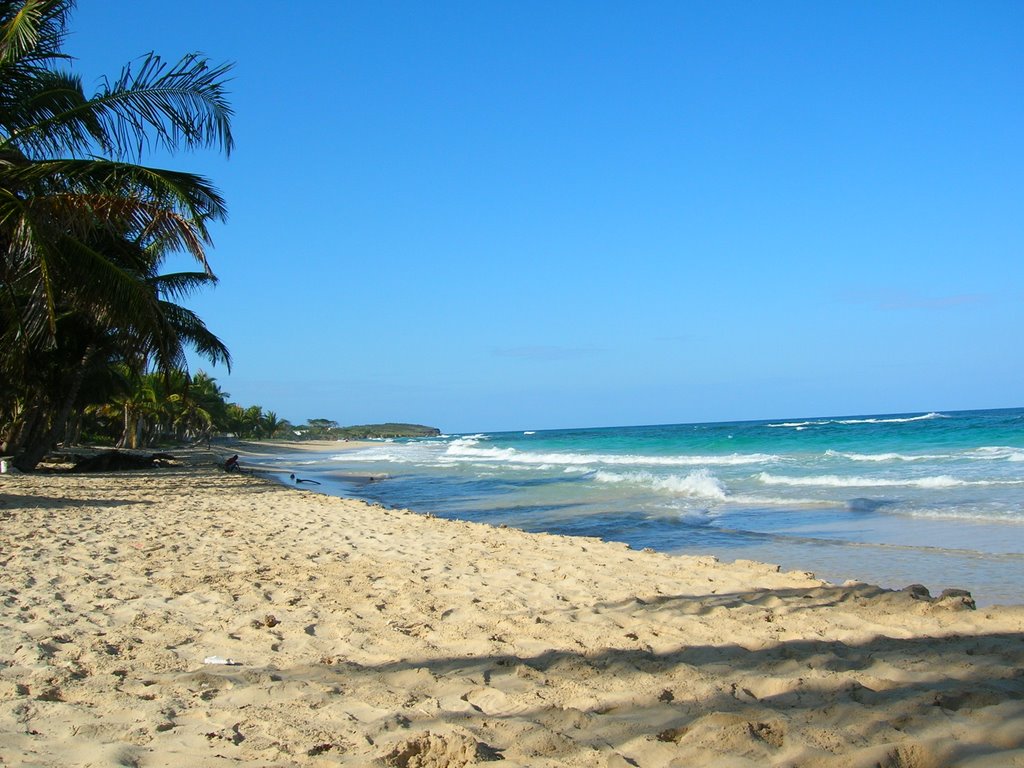
some more pics.

also, some jamaican ways to announce (in bars, shops, etc.) that no credit will be given to customers:

'MR CREDIT IS A BAD DISEASE. BUT DON'T WORRY, YOU WON'T GET IT HERE'

'NO MORE MR CREDIT. HE DIED IN A CAR ACCIDENT ON HIS WAY IN FROM THE JAZZ FESTIVAL'

???

Monday, February 12, 2007

Jamaica

by the way. this is my getaway from everything having to do with war, lebanon, last summer, etc. it's working!


at miami airport. the immigration people weren't as friendly as this guy and had a lot of intelligent questions about the lebanese, syrian, jordanian and egyptian stamps in my passport (my favourite: "so what is it that you DO, ma'am?", or maybe: "so how was the middle east, ma'am?"). this of course after the iris and fingerprint scans. nice.


downtown kingston is scary!!


on top of blue mountain peak


lynette, owner of coffee fields, runner of whitfield hall guest house, generally the boss of the show


yes. at long bay.


at dicky's - a small rastafarian restaurant. please note the carefully folded napkins with ganja motif.


a "man trap" from the days of slavery. oh my.

Monday, July 31, 2006

Evacuated from Beirut

Although there was so much, in my opinion a bit too much, attention paid to the evacuation of foreigners from Lebanon, I decided to write something about my personal evacuation experience.
I took the decision to leave about eight hours before we were due to go - around 11pm on Tuesday night. In the end it just felt like I wasn't doing anyone a favour by staying, all (well, almost all of them) my Lebanese friends were telling me to go and be safe, and so was everybody I know in Germany. So I decided to do it, even though it felt particularly nasty to be leaving as part of a 'green light' the international community was giving Israel by evacuating its citizens from Lebanon. 'Once we're out, you can go ahead with the real stuff' may have been the logic, or maybe it was Israel contacting European governments and telling them, 'guys, you've got 48hours to get your people out of there'.
That's what the German airforce crew on our evacuation plane were speculating anyway, they were saying that the really short notice for evacuating Germans was probably due to the fact the German government hadn't been planning on doing this until they got a definite call from Israel.
It was a really long journey until we got on that plane in Turkey though. First we had to assemble at 7am outside the BIEL conference venue in the port of Beirut. After queuing for three hours in the already unbearably strong sunshine with about 1,000 others, we were told that the first batch of buses had gone and that we should come back in a couple of hours. By this point, several people had fainted and one person had been severely injured because they were squashed against the separation barrier where several Lebanese army and German embassy staff were checking everyone had a German passport. There were definitely not enough embassy people around to inform people what was going on - they had one guy with a megaphone shouting 'everyone will get on a bus', but somehow he didn't manage to get through to the majority of people. Besides, all this was hard to believe in the midst of the pushing, fighting for space, the heat and the occasional outbreak of panic anyway. People panicked out of worry they wouldn't be able to get on a bus, or that they would get separated from friends or family. All the children and babies were crying because of the heat and stress, parents were losing their nerve - and all of this got worse when Israeli planes bombed a storage facility in Achrafiyeh, near Sodeco, about 5 mins by car behind us.


Anyway, I had made it right to the front and was literally standing in front of the separation barrier when they closed it and told everyone the next buses would be arriving in two hours' time. A lot of people were jumping the barrier at this point, with the Lebanese guards letting them be. One man came running and pushing up to the barrier with his two kids in his arms, furious and sweaty, and shoved them into the arms of one of the soldiers guarding the barrier. 'I want my kids to get out, do something' he shouted at the soldier, who told him to calm down and behave and handed the kids back across the barrier.
It felt a bit stupid to actually turn back from the gate like a civilised person, considering that everyone else was of the view that by this time, everything counted to get out and breaking the rules was o.k. and jumping the barrier was in order. But that's what I did anyway, I remember thinking for better or worse... I came back after two hours and most of the morning crowd were gone then - buses started arriving from Sidon in the South carrying more evacuees, who at this point had already been on the road for 4-5 hours with their lives in danger from Israeli bombardment. Accordingly, they were even more stressed than people had been in the morning. There were a lot of fights after we got through the barrier and had to wait for another hour or two in the sun, just to catch a shuttle bus to the main conference centre (a distance of about 500 metres). They wouldn't allow us to walk there, and for this purpose had armed German security guards on call. Next to us, the Canadians seemed to be evacuating people at a much faster pace, sending more buses and pickups...
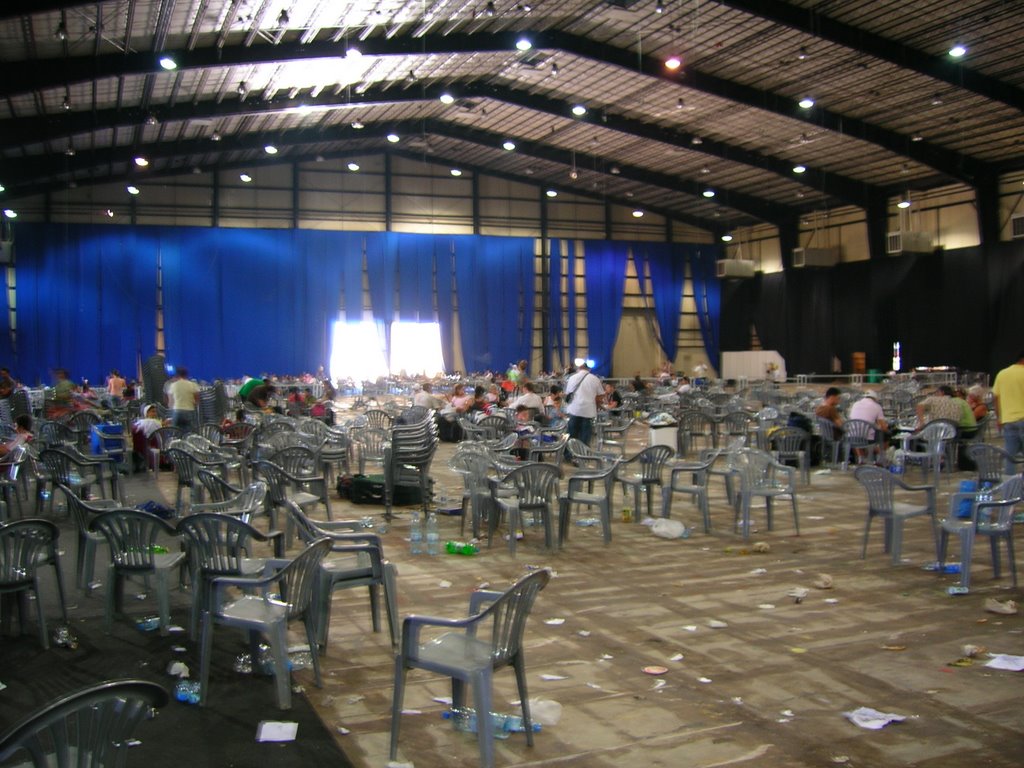
After I finally made it to the conference centre and registered with the German embassy staff (more waiting of course), I had to wait in a huge hangar, bare apart from a lot of plastic chairs, with my fellow evacuees, i.e. about one to two thousand people. Even the German ambassador was helping with the registration, but by this point nobody was surprised about anything anymore. The majority of us were to be taken by bus to Damascus, but as I was waiting to register, an embassy person had asked me if I was willing to travel to Turkey instead. They had negotiated another evacuation route through Syria and to Turkey and were asking anyone not travelling with small children to take that road, because of the longer bus ride.


Unfortunately our bus convoy was the last to leave, at about 7p.m., so we had quite a long wait... there was no food anywhere, except a few lunch boxes which we suspected were left over from the Canadians, and of which my new-found traveling companion managed to get her hands on a few. But then they had told us to bring food to last for 24 hours, along with our ten kilo evacuation allowance...
Once we got on the way, in a strangely surreal dusk with a beautiful sunset - surreal because all the roads were deserted where they would normally have been bustling on a weekday night - everyone started to relax a little. It almost felt like we were taking a road trip, except that things remained strangely tense, and with every major industrial facility we passed (refineries, fuel storages, etc. - and there are a lot of them on that road), people held their breath a little. You never know.
And then there were the fights: we made one stop on our four-hour trip to the border to buy some food and use the bathroom, and there were lots of fights in the queue: 'I was first!' 'No, you bitch, I was!!'. And between grown-up people, mind you. So much for the road trip feeling.
At some point in the middle of the night we got to the Lebanese-Syrian border. I was by this time listening to music on my discman to escape the hectic feeling of the bus and the arguing and the noise. All of a sudden I could hear a strange sound, and people on the bus began to panic. There had been bombing really close to us, two explosions. We were waiting at the border crossing for our passports to be stamped then, and suddenly all the cars around us turned out their lights, people started panicking and running and speeding to the border - on foot, in cars, a minibus full of families had broken down and some of the passengers were desperately trying to push it across the border, to the Syrian side, to safety. The soldiers at the crossing started screaming at us to get the hell out of there with our buses (potential targets, after all the Israelis had already bombed some tour buses in the previous days, saying that they might carry Hizballah weapons), and the people who had gotten off the bus for a cigarette just had time to jump back on before our driver tore up the bumpy road and crossed the border, which the guards had opened to let everyone through. Once on the other side, we had to wait for about three hours, because our passports along with a German army guy accompanying us had been left at the border crossing post.
These three hours were the most terrible part of the journey. We were waiting, we didn't really know what was going on, and people still kept passing us, whole families coming across the border barefoot, carrying the kids and a few belongings. Everyone kept telling us to get out of there because they were bombing close-by. The rumour started circulating that the bombs had targeted the village we had just passed through, and had destroyed the road, cutting the only land route out of Lebanon. It was an agonising wait then, all I could think about were the Lebanese friends who had been planning to take that road the next day, and who would now be unable to leave. I desperately wanted to know if it was really true, but as rumours go there was no way of knowing for sure. And who was I to ask or to share those worries with? My fellow passengers had mostly been through hell at this point, one guy kept telling us over and over how his village close to the Israeli border had been bombed into the ground, and how he had spent the past four days without sleep, pulling bodies from the rubble of destroyed houses, putting extra fridges into the hospital morgue because there were too many bodies...
Finally the army guy reappeared with our passports, and we got back on the bus and into the 'calm' of journeying through relatively safe Syria. The panicking had really taken a toll on everyone's nerves though, and somewhere near Aleppo a big family feud broke out on my bus, with several women going at each other with their high-heeled shoes as attack weapons, and the men unable to separate them. This whole affair delayed our journey by another half hour or so. Early in the morning we were roused from sleep (at least I was) and told to get all our stuff and change onto another bus. At some point we stopped at a hotel, already inside Turkey, to get some food and eat their nice breakfast buffet, but I wasn't hungry at all actually. I remember desperately trying to ask the waiter for a fork, but he didn't understand what I wanted to tell him. A German TV crew had already been flown in to meet us there, and started interviewing people about the journey and about how well (or badly) the German embassy had been managing the evacuation. It all felt really surreal. I didn't want to speak to or see anyone. Strangely, there was a really nice and completely empty jacuzzi-swimming pool thingy which I found while wandering around the hotel, and I would have loved taking a swim in there, but my fear of getting left behind by the bus was stronger.
We continued our journey through the amazingly beautiful scenery of South-East Turkey, which nobody was taking much notice of anymore, but it definitely added to the trip in some way. At Adana airport, the final stop of our 20-hour bus ride, there were more television crews and more waiting. We could already see the German airforce plane waiting for us on the runway, but for some reason it took them a few hours to sort everything out and let us on. A coke at the only snack bar in the waiting lounge cost 4 US dollars, a definite dissuasion.


Finally on the plane, we were greeted by seats much wider and much more comfortable than on a commercial airliner, and instead of air hostesses there were soldiers pushing around little trolleys with food and drink. They even served tomato juice (why does everyone drink that on the plane, anyway?!). Evacuation heaven!
And then we had at last made it to Cologne airport, and by then the German authorities apparently were feeling thoroughly bad about all the negative press they'd been getting. All of a sudden there were all these people to take care of us, medics, counsellors, railway employees to help organise onward journeys.... We were a bit surprised, considering all the official company we'd had on the journey had consisted in our German army escort, who by the end had become quite dear to us and vice-versa, and who said his farewell to each and every one of us as we got on the plane (he turned right back around to accompany the next convoy to Turkey).

Tuesday, July 18, 2006

More bad news

Everything continued: last night they were bombing Beirut (usually between 3 and 4 in the morning). Today pretty much the whole country was under constant attack, the South, the Bekaa, even Zahle apparently, which is a majority Christian area. The count of dead civilians is now at around 200, plus 30 Lebanese soldiers who were killed in air raids on their barracks. The really worrying thing: Israel is on record as saying that this is legitimate, that they are planning to continue the attacks for several weeks even if there ARE negotiations for a cease-fire, and by the way, that civilians are legitimate targets because they all condone Hizballahs actions. And their conditions for negotiating are unattainable: Hizballah should release the two captured soldiers as a precondition for negotiations. This is a strategy of deliberate escalation, obviously - and yes, let's remember that Hizballah were saying right away, on Wednesday when they first captured the soldiers, that they are ready for negotiations and a prisoner swap. Then Israel started the bombing and we got to where we are now. If you don't believe this, read up on it please - it's Israel that everybody needs to pressure for a cease-fire now, it's as simple as that. And why is nobody doing it?

Here in Beirut things are getting increasingly chaotic. So many people came up from the South now (don't ask me how, a lot of them presumably walked it because all the roads and bridges are destroyed) and from the destroyed suburbs that the schools are full and providing for all these peoples' basic needs is becoming increasingly difficult. Yesterday I was at a meeting - a large part of it a pointless discussion about how Lebanese civil society should react to the attacks - where some people were organising supplies and coordinating volunteers for distributing them to those in need.

Today the health minister came on TV calling for help because there is a humanitarian crisis in the South: it's completely disconnected and blockaded, there is not enough food, no medication (including anaesthetics, for example), and still the bombings continue. Does anybody know this where you are? There have been air raids on hospitals, and today on a bus carrying donated medication from the UAE which was completely destroyed.

I am debating now whether to leave the country on a bus to Syria, the German embassy is evacuating people. You have to bring food and water to last for 24hrs (because of the long queues at the border), enough cash in USD, and everyone is only allowed one bag of 10kg. The Israelis are also bombarding the North, which is the only route now on which you can leave by land, but presumably the German embassy will be coordinating their transport with them. I don't know.

Monday, July 17, 2006

All hell broke loose

In the past days the situation has really escalated so much, it's hard to even begin to understand it. A few days ago everyone thought this would have to end soon. But it just keeps going, and getting worse. To recap some of the main facts, Israel has now really destroyed all important infrastructure: roads, airports, ports, radar systems, you name it. And they keep carpet bombing all of South Lebanon, including with outlawed weapons like cluster and phosphor bombs. 141 civilians had died at yesterday's count. I don't know if you get these pictures where you are, but the destruction is massive, entire villages just flattened. Also, Haret Hreik in the Southern sububurbs of Beirut, where Hizballah used to have its HQ, is virtually gone. I'm not exaggerating, the Israelis have been bombing it for 5 days now and it's gone. Today I saw my colleague Badia here at the office. She used to live there for many years (and by the way, no she is not a Hizballah militant) and had just sold her house 2 months ago and moved to a different part of town. She still had all her stuff in the house, though - and now it's all gone. A pile of rubble. Her sister's house is also gone, and she was still living there. Nobody will compensate them. They couldn't take any of their belongings. On top of that, their family members got stuck in a town in the South, and are today on the road trying to reach Beirut, literally risking their lives in doing so - but they had to leave the South because it's even more dangerous there.

Beirut has also changed a lot. The streets were completely deserted over the weekend, everyone was at home waiting to see how things would turn out. You could hear the bombings all over Beirut, they were mostly bombing at night but occasionally during the day, too. On Saturday I was briefly at home when they started bombing the port, about 1 km away from my house. You can imagine what I felt like when I saw the shells falling and exploding and felt the blast shaking the house and rattling the windows: a few seconds of pure panic, before I realised it was a limited operation and it was calming down again. I moved to a friend's house in a different part of town after that, and have been staying with her and her family, which is really nice. There is no way anyone can be on their own in a situation like this.

Today there are a few more people on the streets, but it's all very tense. More and more refugees from the South keep arriving, they are sleeping in schools which have all been opened. People are descending on the stores that are open and hoarding food, even though that might not be necessary and supplies aren't short yet. Everybody is incredulous at what's happening, although that sentiment gets covered by worry and anxiety most of the time.

I feel that people are also very afraid that everyone's abandoning them - and that sentiment is very real. To hear the G8 summit declare their 'concern' about the situation and see the Security Council fail to pass a resolution calling for a cease-fire is really very depressing. It feels like Israel is on a rampage and no-one's willing to stop them. Now most countries are evacuating their citizens from here, and that's a further blow to the morale. Mind you, none of these are forced evacuations - it's only for people who want to leave. The German embassy is advising all citizens who are residents here to stay put for the moment, which is what I've decided to do (independently of their advice). It just feels like I'm not going to abandon my whole life here just now.

Mahnwache

Im Nahen Osten eskaliert die Gewalt, jeden Tag sterben im Libanon, in
Israel und im Gaza-Streifen zahlreiche Menschen und man hat das Gefühl,
es geschieht nichts. Jedenfalls ging das mir und einigen Freunden so.
Deshalb rufen wir ab

HEUTE, MONTAG, 17. JULI 2006

an jedem Werktag von 17 – 19 Uhr zur

MAHNWACHE VOR DEM AUSWÄRTIGEN AMT auf.

Wir wollen die Bundesregierung auffordern, sich unverzüglich und aktiver
für die Beilegung der Gewalt im Nahen Osten einzusetzen.Anbei findet ihr
ein Flugblatt mit Forderungen, für weitere Infos könnt ihr euch an
zurueckhaltung_ist_ohnmacht@yahoo.de
oder an mich unter 0176 /
2919 1593 wenden. Online:
http://www.geocities.com/zurueckhaltung_ist_ohnmacht/

Kommt zahlreich, und wenn es nur für eine halbe Stunde ist!

Und BITTE LEITET DIESE MAIL WEITER – an Freunde, Verteiler oder
Medienvertreter – wer euch so einfällt! Sorry for x-posting.

Viele Grüsse,

Silke Lode

Text auf Deutsch

Seit letztem Mittwoch ist Libanon unter israelischer Bombardierung. Innerhalb von 2 Tagen wurde nahezu die komplette Infrastruktur des Landes zerstoert: der Flughafen ist geschlossen weil Landebahnen und Treibstoffvorraete getroffen wurden, alle wichtigen Bruecken sind zerstoert und sich ueber Land fortzubewegen ist sehr schwierig und wegen der andauernden Luftangriffe lebensgefaehrlich. Ausserdem wurde eine Seeblockade eingerichtet und die israelischen Kriegsschiffe bombardieren vom Meer aus. Als naechsten Schritt hat Israel alle Hizballah zugerechneten Einrichtungen bombardiert, darunter auch einen ganzen Stadtteil im Sueden Beiruts (Dhahiyeh Janubiyeh), der mittlerweile voellig zerstoert ist. Gleichzeitig befindet sich der Suedlibanon unter andauernden Bombardierungen, laut al-Arabiya TV auch mit verbotenen Cluster- und Phosphor-Bomben. Die Situation im Sueden des Landes ist katastrophal: es gibt keinen Strom, kein Wasser, keine Medikamente und nicht genug Lebensmittel. 141 Zivilisten sind bis jetzt gestorben (16. 7.), mehrere Hundert wurden verletzt. Wegen der zerstoerten Infrastruktur ist es schwierig fuer die Menschen zu fliehen und viele versuchen zu Fuss nach Beirut zu gelangen. Die Fluechtlinge, die es bis hierher geschafft haben, schlafen im Freien oder werden in Schulen untergebracht. Am Samstag hat Israel ein Krankenhaus in Tyr bombardiert. Wegen der andauernden Angriffe kann das Rote Kreuz an vielen Orten weder Leichen evakuieren noch den gestrandeten Zivilisten Hilfe leisten. Viele Doerfer und Staedte sind voellig zerstoert, gestern kamen 20 Zivilisten bei ihrem Fluchtversuch um, nachdem Israel alle Bewohner eines Dorfes zum Verlassen des Ortes aufgefordert und dann das Dorf bombardiert hatte. Sie befanden sich bereits auf dem Weg nach Beirut. Ebenfalls gestern bombardierte Israel eine Notunterkunft voller Fluechtlinge, 20 Tote. Abgesehen von der humanitaeren Katastrophe im Sueden des Landes (ich wurde heute verzweifelt von einem Mann kontaktiert, dessen Familie im Sueden von der Aussenwelt abgeschnitten ist und die im Kontakt zur Deutschen Botschaft ihre letzte Chance sieht) und der Atmosphaere der Angst und Verzweiflung angesichts der Untaetigkeit der internationalen Gemeinschaft, die sich ueberall breit macht, sind die wirtschaftlichen Schaeden kaum abzusehen: der Wiederaufbau der Infrastruktur allein wird mehrere Jahre in Anspruch nehmen, die fuer die Wirtschaft unerlaesslichen Einnahmen aus der Tourismusindustrie sind verloren, alle wirtschaftliche Aktivitaet ist zum Erliegen gekommen, wichtige Ernten koennen nicht eingebracht werden. All dies wirft die Entwicklung des Landes um Jahre zurueck.
Bei diesem Angriff geht es nicht mehr um die Befreiung zweier israelischer Soldaten. Die Gefahr einer regionalen Eskalation ist heute real, und die unverantwortliche und voellig unproportionale Reaktion Israels auf Hizballahs Provokation ist dafuer der Hauptgrund. Die libanesische Regierung ist nicht in der Lage, Hizballah zu konfrontieren: dies wuerde unweigerlich zu einem neuen Buergerkrieg im Libanon fuehren. Internationaler Druck auf Israel fuer eine sofortige Einstellung der Angriffe und eine diplomatische Loesung sind der einzige Weg aus der Krise, was auch das Leiden der israelischen Zivilbevoelkerung beenden wuerde. BITTE GEHT AUF DIE STRASSEN UND FORDERT DIE REGIERUNG ZUM HANDELN AUF!!!!!!!!!!!!!!!!!

Thursday, July 13, 2006

They're imposing a blockade now

Israel has decided that all of Lebanon needs to pay for what Hizballah is doing. So, they're now blockading all access to the country by air, land and sea. How long, I wonder, will they keep doing this? Are they aiming for food shortages? What a civilised answer: the only democracy in the Middle East is imposing a brutal siege on the only other democracy in the Middle East!

Meanwhile, pictures on TV show destroyed villages in the South of Lebanon with smoke rising from them, burning fields, destroyed bridges that it will cost hundreds of thousands of dollars to repair, ruins of houses - one with a lifeless human foot covered in dust sticking out from underneath concrete rubble -, people getting in their cars and carrying babies away with them, presumably trying to reach Beirut where they will be safe. Only they can't reach here anymore, because all the main roads between here and the South have been destroyed by Israeli shelling.

--- PLEASE STOP THE MADNESS!! ---

For a while now I have been thinking, as I'm sure all of us do occasionally, about why it is that there is so much trouble and strife in this region. And much of our work here is focused on bringing more women and more young people into decision making. Occasionally I've been asking myself if that is actually such an effective strategy, given the big problems going on. But yes, now that all this is happening I find myself thinking: what if younger people with a different perspective and less long-brewed hatred, and a few more women made decisions over here? Maybe it wouldn't get so bad so quickly! Because now, non-elected middle-aged men with a military background seem to be making ALL the decisions on everyone's behalf, and look what's happening! They're at each others' throats, and they can't get enough of it either.

Going backward, fast

Ok, I hate to be sensational. But it really makes you wonder - Israel has effectively managed to close Beirut's airport. Meaning, we're trapped here. This feels bad. But then, that's only a minor problem (although economically it's going to cause Lebanon huge damage). 20 civilians were killed in the South this morning, in just a few hours. Including one entire family killed in their house. Israel thinks it is going to war with the Lebanese government. I'm sure the majority of Lebanese would disagree with that interpretation. The main bridge between Beirut and Saida was hit too, so you can't go to the South anymore, either, even if you wanted to.

This morning I woke up early and all was quiet; there is almost no traffic today anyway because people are scared and staying at home if they can. And I swear I could hear, ever so faintly, helicopters and several explosions in the distance. Makes sense, because Israel also bombarded Hizballah's al Manar TV station which is located in a southern suburb of Beirut. My colleague here at work used to live in that suburb for a long time, she even remembers when it was a 'mixed' (meaning: including inhabitants from different confessions) residential neighbourhood. Before all the recent insanity that all sides have incited. And, without excusing Hizballah's ideology or their stupid actions, let's remember how they got to where they are today, and to what they are today: weren't they founded after Israel's 1982 invasion? Doesn't this make anyone go, STOP IT YOU CRAZY IDIOTS!!! RIGHT NOW!!!! ALL OF YOU!!! Anyway that's how I feel. And yes, for the sensational bit, check out this Time magazine cover from August 1982:

Not to mention these quotes from Dan Halutz, who is the IDF Chief of Staff: "We will turn Lebanon's clock back 20 years."

Or this one from today's Ha'aretz: "The IDF General Staff took a similarly hard line, with one senior officer declaring that Israel should send Lebanon's infrastructure "30 years backward" in response to the attack."

http://www.haaretz.com/hasen/pages/ShArt.jhtml?itemNo=737860&contrassID=1&subContrassID=0&sbSubContrassID=0

Wednesday, July 12, 2006

Sound familiar?

This country is actually under attack by Israel right now, after Hizballah kidnapped two Israeli soldiers:

"Immediately following the incident, IDF Chief of Staff Dan Halutz headed into the military's war room at the Defense Ministry complex, Channel 10 TV reported. In consultations, senior IDF officers called for an end to the restraint against Hezbollah and said Lebanon should be made to pay a heavy price.

Halutz ordered the IDF to mobilize a reserve infantry division that was expected to be sent to Israel's northern border with Lebanon. General Staff exercises held over the past several years tested a number of possible responses to kidnapping scenarios. One of these responses involves the massive incursion of IDF ground forces into Lebanese territory. Military sources told Haaretz that Israel is liable to act with the aim of "altering the rules of the game on the northern front."

The IDF also ordered troops deployed on the Lebanon and Gaza borders on high alert in the event that armed groups may attempt to fire Katyusha and Qassam rockets into Israel.

[...]IDF responded to the attacks from Lebanon with heavy artillery and tank fire. Al-Manar television reported that IDF artillery was pounding the fringes of the villages of Aita el-Shaab, Ramieh and Yaroun in the hills east of the coastal border port of Naqoura. Israel Air Force struck roads, bridges and Hezbollah guerrilla positions in southern Lebanon, Lebanese security officials said.[...]
Lebanese security sources said two Lebanese civilians were killed and a Lebanese soldier was wounded in an IAF air raid on a bridge in south Lebanon on Wednesday. The Lebanese casualties occurred in the raid on the coastal Qasmiyeh bridge."

Ha'aretz online edition, July 12, 2006
http://www.haaretz.com/hasen/spages/737634.html

Monday, July 10, 2006

Long time

Ok it's been more than two months since I last posted anything here. I'm sure everyone has stopped checking in on my blog anyway: PUBLISH OR PERISH, right?? Only I really really haven't had time to post anything recently, especially because it's been very eventful, and summarising that seemed a little difficult. To give it a try: quit my old job and found a new one. Went to Germany for training with new job, there saw lots of dear friends and enjoyed the beauty of Berlin. Came back, went to Damascus several times. Silke and Julia came to visit. Went to Cairo for more training with the new job. Really enjoyed that, Cairo is great. Came back here and had to look for a new apartment. Started this process, including shady estate agents, aggressive neighbour's dogs, finally success in the form of a new apartment with a great view but also a lot of noise, and an ant's nest in the bedroom (will be taken care of by fumigation experts next week - run while you can, shitty ants!!!). Summer is here and we're going to the beach. I have decided that I need to go back to Berlin sooner rather than later. Germany got kicked out of the world cup by Italy, who seem to specialise in waiting for their lucky streak until the very last minute. Can't believe it. Lebanese politicians are continuing to throw insults at each other, backed up by their respective religious authorities or offending them, respectively, whatever will guarantee them more media attention. People continue to despair at the sight and sound of this (ask any taxi driver). Summer is going on and people are going to the beach....Did I forget anything? I will post some pictures soon.

Monday, April 10, 2006

Beiteddine, non-existing Chouf cedars and getting high off of mountain air

Renting a car in Lebanon is really cheap and you can just take off and go see some amazing scenery in a day...and there really are some spectacular sights around. It has to be said, despite my current rather negative attitude towards the country. So that's what I did last weekend with some friends. We first went to Beiteddine, which is an old family palace and is really pretty.


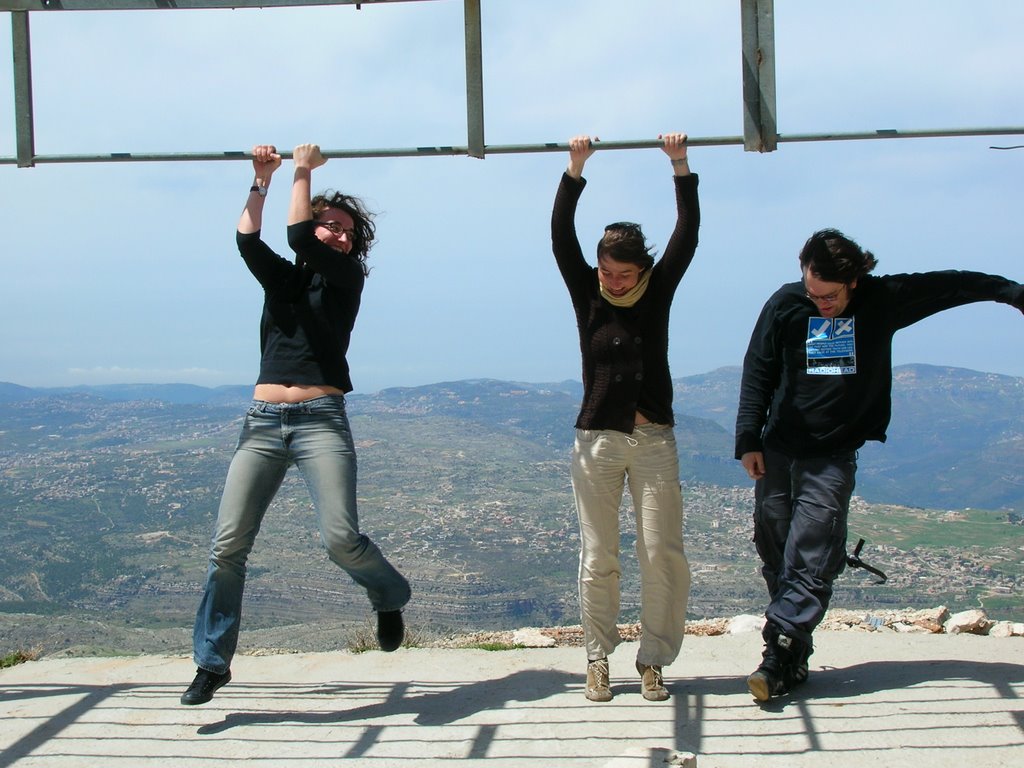
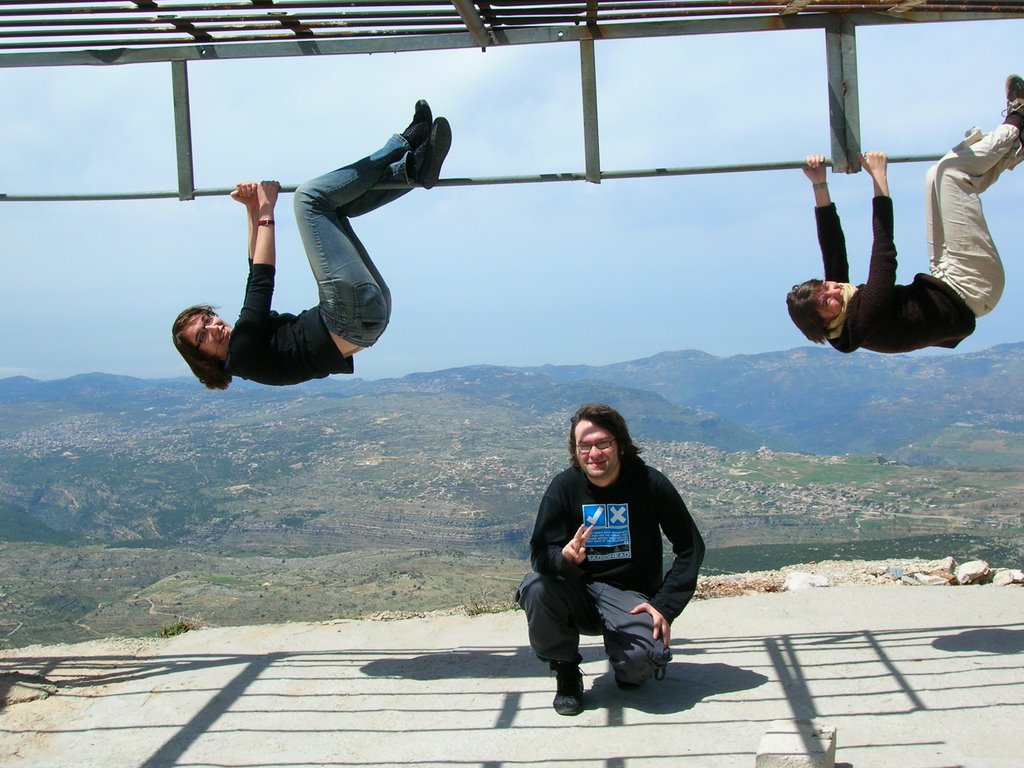
Next, we tried to find the Chouf Cedar Reserve, which is quite high up in the mountains. We did see about three cedar trees (the first ones I've seen here!!) behind a fence, but somehow the 'reserve' appeared to be closed and we couldn't go in. So we just kept driving up the mountain until we got to the top, where the lack of oxygen or something made us really really silly. Check this developing photo story:


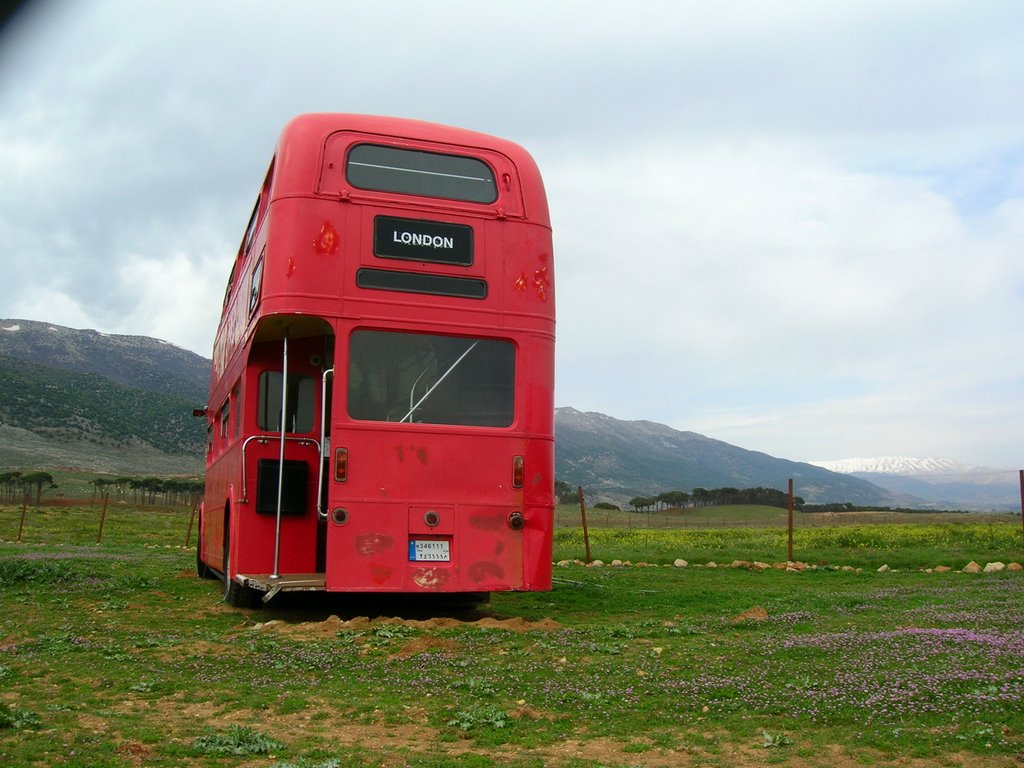
To top it all off, we had a picnic in the Bekaa valley (after manoevring the car through the last remaining bits of snow on the pass road) and found this really bizarre sight in the middle of nowhere!

Muriel was here


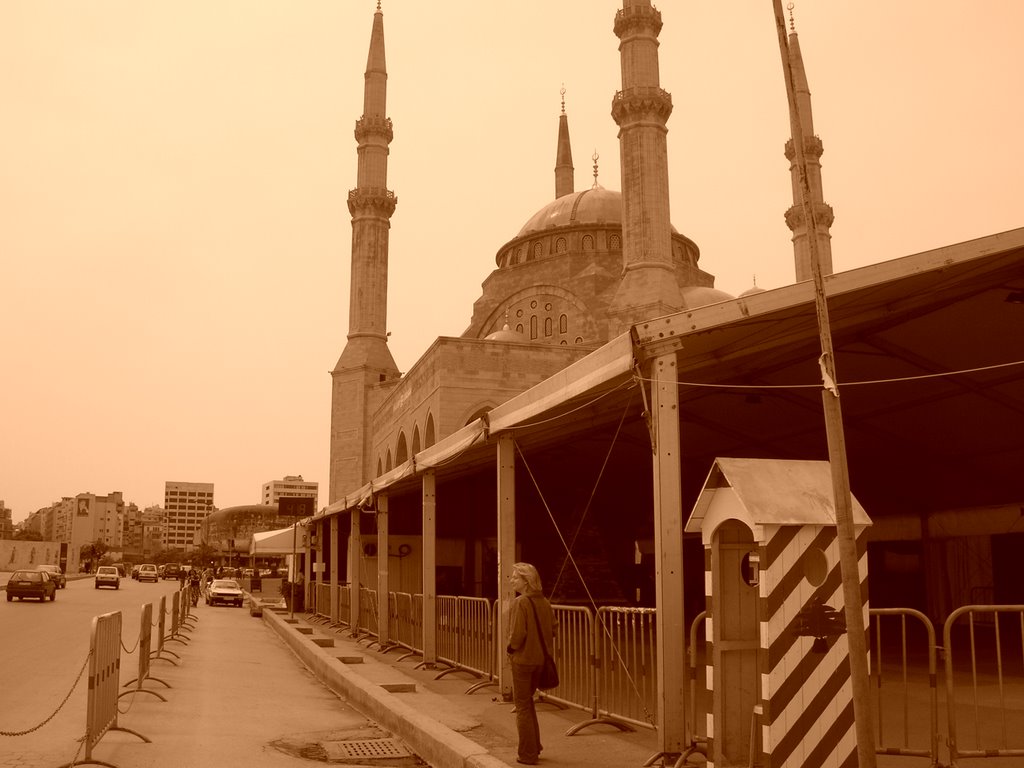
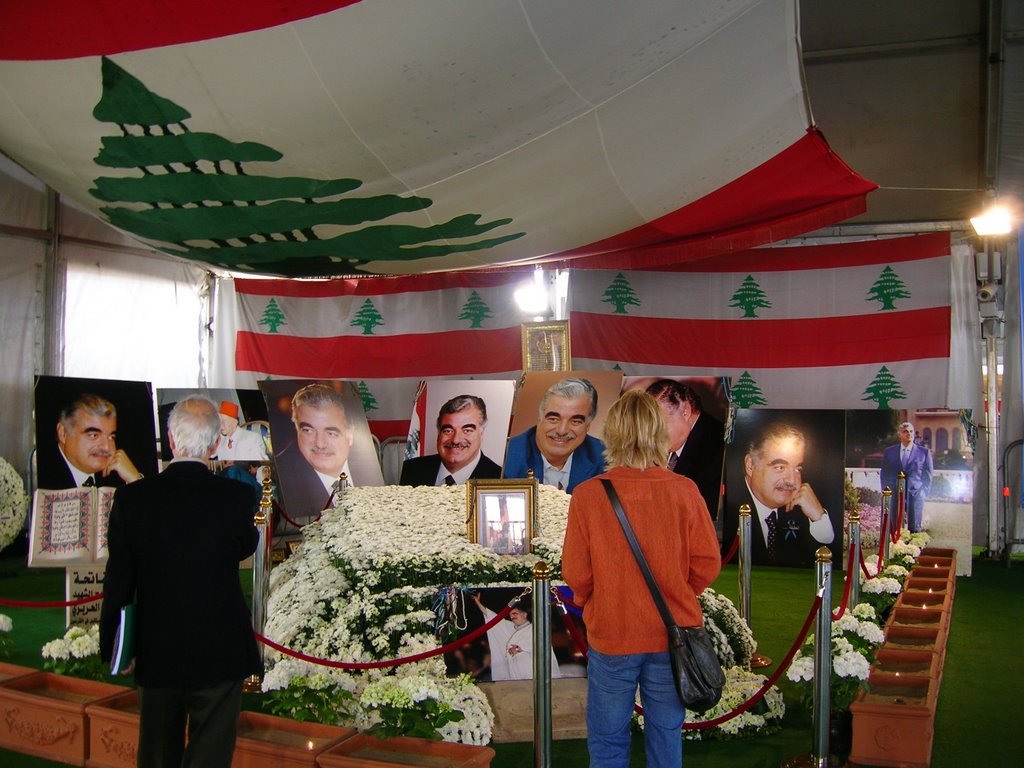
... for about 24hrs and we talked a LOT and ate yummy food - with a view of a guy with an outsize albino boa constrictor around his neck - and visited some major sites (Hariri's grave, Virgin Mega Store...) and smoked Argileh and it was great. I feel homesick. I want to go to Berlin.


Wednesday, April 05, 2006

Weird Story

OK, check this out. Very strange indeed. It's a story about information flow, in its various forms, and about life in this region. It happened yesterday.

My landlord - let's call him Elie; this is what living in a paranoid country does, by now I don't think it absurd that 'General Security', the not-very-secret secret police here might get bored and start doing blog searches for the term 'Beirut', and I don't want to pass them any real names - had been telling me that he'd been receiving phone calls for me on his mobile. In these calls, a guy with a strange accent ('like Gulf Arabic, you know what I mean', as Elie puts it in his own strange American accent - I am not good at covert action apparently, I am giving him away already!) had told him 'I have money for Eva'. Naturally, before he told me this, Elie had asked me inconspicuously if I happened to be waiting for any money shipments. Why give away any information without doing a bit of intelligence gathering first? You never know!

Anyway, so eventually I managed to obtain the number of this money-guy from my landlord. 'He's an Israeli', was his latest conspiracy theory about the mysterious caller. Never mind that you can't even travel to Lebanon with an Israeli stamp in your passport, let alone an actual Israeli identity. When I called, the pseudo-Israeli solved part of the mystery: the money he wanted to give me was money that the owner of my flat in the US owed me. Instead of wiring it and paying fees for it, he apparently preferred to send it through a trusted friend. No problem. Except that he could have told me before so that we could have skipped the whole Gulfie/Israeli part.

As the money guy - I still hadn't managed to find out his name - was a new arrival in Beirut, further fuelling the foreigner conspiracy, we agreed that I would come to the suburb where he was staying (New Jdeideh) and meet him in front of City Mall. So I spent about 45 minutes in a service (shared) taxi stuck in traffic and cruising through New Jdeideh, an apparently poor part of Beirut where the remains of civil war damage stand out much more prominent and ugly than in other parts, until I finally was told to get out in the middle of a roundabout and right in front of the new, shiny City Mall by the highway. A direct taxi would have taken about 15 minutes, but they do get quite expensive. Unfortunately I still had to cross the highway, which almost cost me my life, but hey what's new, this is normal in Beirut.

In front of City Hall, I had to call the guy again because he apparently forgot about our appointment (also a normal feature of life here). He said he would be right there and that his name was Hamid. I told him that I wear black-framed glasses - not too common here, unlike in Europe - so he'd recognise me, and sat down on a bench facing the entrance. One, two, three guys walked in through the glass door after being checked by the security guard, and all of them stared at me, presumably because I was staring at them, trying to figure out if they might be Hamid the money man.

Finally he arrives, a square-looking guy with glasses and a leather coat and a big friendly smile. He apologizes for the delay and pulls out his wallet to hand me the money in US dollars. By now I feel really tired and slightly irritated with the whole episode, if not at Hamid who is after all doing me and the flat-owner (almost wrote his real name...!) a favour. To be polite and despite feeling really tired and just wanting to get out of the blasted City Mall asap, I ask him where he is from - Iraq - and what he is doing here, is he visiting? Hamid looks at me slightly apologetically and points at his head. 'I am here for medical treatment. I live in Baghdad and a car bomb exploded next to me, and now I have some problems with my eyes.' My head feels really heavy and I feel a little bit betrayed by this sudden revelation - how could that just come out of nowhere?? Now I notice several auburn marks on his head and neck that look like scars. I feel like I should be doing or saying something appropriate, only I have no idea what that might be. 'I hope you'll be better now', is all I manage. Hamid smiles and says with a giggle, 'Insh'allah!'. That's a good one! 'Insh'allah', I reply, having learned that you can't really go wrong with that answer, and he shakes my hand with a firm grip like he would with one of his buddies, not like a man would with a woman (according to my own Middle East experience). And then he just vanishes through the glass doors, and I stay behind clutching the stupid dollars and feeling terrible, and wanting to run after him and make up for that terrible thing that happened to him! Instead, I walk into the next mall store, the Geant supermarket, and wander around slightly bewildered between giant aisles of imported French cheese.