Israel has decided that all of Lebanon needs to pay for what Hizballah is doing. So, they're now blockading all access to the country by air, land and sea. How long, I wonder, will they keep doing this? Are they aiming for food shortages? What a civilised answer: the only democracy in the Middle East is imposing a brutal siege on the only other democracy in the Middle East!
Meanwhile, pictures on TV show destroyed villages in the South of Lebanon with smoke rising from them, burning fields, destroyed bridges that it will cost hundreds of thousands of dollars to repair, ruins of houses - one with a lifeless human foot covered in dust sticking out from underneath concrete rubble -, people getting in their cars and carrying babies away with them, presumably trying to reach Beirut where they will be safe. Only they can't reach here anymore, because all the main roads between here and the South have been destroyed by Israeli shelling.
--- PLEASE STOP THE MADNESS!! ---
For a while now I have been thinking, as I'm sure all of us do occasionally, about why it is that there is so much trouble and strife in this region. And much of our work here is focused on bringing more women and more young people into decision making. Occasionally I've been asking myself if that is actually such an effective strategy, given the big problems going on. But yes, now that all this is happening I find myself thinking: what if younger people with a different perspective and less long-brewed hatred, and a few more women made decisions over here? Maybe it wouldn't get so bad so quickly! Because now, non-elected middle-aged men with a military background seem to be making ALL the decisions on everyone's behalf, and look what's happening! They're at each others' throats, and they can't get enough of it either.
Thursday, July 13, 2006


Going backward, fast
Ok, I hate to be sensational. But it really makes you wonder - Israel has effectively managed to close Beirut's airport. Meaning, we're trapped here. This feels bad. But then, that's only a minor problem (although economically it's going to cause Lebanon huge damage). 20 civilians were killed in the South this morning, in just a few hours. Including one entire family killed in their house. Israel thinks it is going to war with the Lebanese government. I'm sure the majority of Lebanese would disagree with that interpretation. The main bridge between Beirut and Saida was hit too, so you can't go to the South anymore, either, even if you wanted to.
This morning I woke up early and all was quiet; there is almost no traffic today anyway because people are scared and staying at home if they can. And I swear I could hear, ever so faintly, helicopters and several explosions in the distance. Makes sense, because Israel also bombarded Hizballah's al Manar TV station which is located in a southern suburb of Beirut. My colleague here at work used to live in that suburb for a long time, she even remembers when it was a 'mixed' (meaning: including inhabitants from different confessions) residential neighbourhood. Before all the recent insanity that all sides have incited. And, without excusing Hizballah's ideology or their stupid actions, let's remember how they got to where they are today, and to what they are today: weren't they founded after Israel's 1982 invasion? Doesn't this make anyone go, STOP IT YOU CRAZY IDIOTS!!! RIGHT NOW!!!! ALL OF YOU!!! Anyway that's how I feel. And yes, for the sensational bit, check out this Time magazine cover from August 1982:
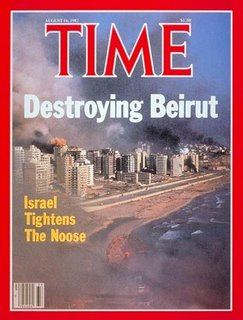
Not to mention these quotes from Dan Halutz, who is the IDF Chief of Staff: "We will turn Lebanon's clock back 20 years."
Or this one from today's Ha'aretz: "The IDF General Staff took a similarly hard line, with one senior officer declaring that Israel should send Lebanon's infrastructure "30 years backward" in response to the attack."
http://www.haaretz.com/hasen/pages/ShArt.jhtml?itemNo=737860&contrassID=1&subContrassID=0&sbSubContrassID=0
This morning I woke up early and all was quiet; there is almost no traffic today anyway because people are scared and staying at home if they can. And I swear I could hear, ever so faintly, helicopters and several explosions in the distance. Makes sense, because Israel also bombarded Hizballah's al Manar TV station which is located in a southern suburb of Beirut. My colleague here at work used to live in that suburb for a long time, she even remembers when it was a 'mixed' (meaning: including inhabitants from different confessions) residential neighbourhood. Before all the recent insanity that all sides have incited. And, without excusing Hizballah's ideology or their stupid actions, let's remember how they got to where they are today, and to what they are today: weren't they founded after Israel's 1982 invasion? Doesn't this make anyone go, STOP IT YOU CRAZY IDIOTS!!! RIGHT NOW!!!! ALL OF YOU!!! Anyway that's how I feel. And yes, for the sensational bit, check out this Time magazine cover from August 1982:

Not to mention these quotes from Dan Halutz, who is the IDF Chief of Staff: "We will turn Lebanon's clock back 20 years."
Or this one from today's Ha'aretz: "The IDF General Staff took a similarly hard line, with one senior officer declaring that Israel should send Lebanon's infrastructure "30 years backward" in response to the attack."
http://www.haaretz.com/hasen/pages/ShArt.jhtml?itemNo=737860&contrassID=1&subContrassID=0&sbSubContrassID=0
Wednesday, July 12, 2006
Sound familiar?
This country is actually under attack by Israel right now, after Hizballah kidnapped two Israeli soldiers:
"Immediately following the incident, IDF Chief of Staff Dan Halutz headed into the military's war room at the Defense Ministry complex, Channel 10 TV reported. In consultations, senior IDF officers called for an end to the restraint against Hezbollah and said Lebanon should be made to pay a heavy price.
Halutz ordered the IDF to mobilize a reserve infantry division that was expected to be sent to Israel's northern border with Lebanon. General Staff exercises held over the past several years tested a number of possible responses to kidnapping scenarios. One of these responses involves the massive incursion of IDF ground forces into Lebanese territory. Military sources told Haaretz that Israel is liable to act with the aim of "altering the rules of the game on the northern front."
The IDF also ordered troops deployed on the Lebanon and Gaza borders on high alert in the event that armed groups may attempt to fire Katyusha and Qassam rockets into Israel.
[...]IDF responded to the attacks from Lebanon with heavy artillery and tank fire. Al-Manar television reported that IDF artillery was pounding the fringes of the villages of Aita el-Shaab, Ramieh and Yaroun in the hills east of the coastal border port of Naqoura. Israel Air Force struck roads, bridges and Hezbollah guerrilla positions in southern Lebanon, Lebanese security officials said.[...]
Lebanese security sources said two Lebanese civilians were killed and a Lebanese soldier was wounded in an IAF air raid on a bridge in south Lebanon on Wednesday. The Lebanese casualties occurred in the raid on the coastal Qasmiyeh bridge."
Ha'aretz online edition, July 12, 2006
http://www.haaretz.com/hasen/spages/737634.html
Monday, July 10, 2006
Long time
Ok it's been more than two months since I last posted anything here. I'm sure everyone has stopped checking in on my blog anyway: PUBLISH OR PERISH, right?? Only I really really haven't had time to post anything recently, especially because it's been very eventful, and summarising that seemed a little difficult. To give it a try: quit my old job and found a new one. Went to Germany for training with new job, there saw lots of dear friends and enjoyed the beauty of Berlin. Came back, went to Damascus several times. Silke and Julia came to visit. Went to Cairo for more training with the new job. Really enjoyed that, Cairo is great. Came back here and had to look for a new apartment. Started this process, including shady estate agents, aggressive neighbour's dogs, finally success in the form of a new apartment with a great view but also a lot of noise, and an ant's nest in the bedroom (will be taken care of by fumigation experts next week - run while you can, shitty ants!!!). Summer is here and we're going to the beach. I have decided that I need to go back to Berlin sooner rather than later. Germany got kicked out of the world cup by Italy, who seem to specialise in waiting for their lucky streak until the very last minute. Can't believe it. Lebanese politicians are continuing to throw insults at each other, backed up by their respective religious authorities or offending them, respectively, whatever will guarantee them more media attention. People continue to despair at the sight and sound of this (ask any taxi driver). Summer is going on and people are going to the beach....Did I forget anything? I will post some pictures soon.
Thursday, May 04, 2006


Monday, April 10, 2006
Beiteddine, non-existing Chouf cedars and getting high off of mountain air
Renting a car in Lebanon is really cheap and you can just take off and go see some amazing scenery in a day...and there really are some spectacular sights around. It has to be said, despite my current rather negative attitude towards the country. So that's what I did last weekend with some friends. We first went to Beiteddine, which is an old family palace and is really pretty.

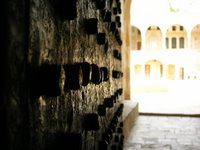
Next, we tried to find the Chouf Cedar Reserve, which is quite high up in the mountains. We did see about three cedar trees (the first ones I've seen here!!) behind a fence, but somehow the 'reserve' appeared to be closed and we couldn't go in. So we just kept driving up the mountain until we got to the top, where the lack of oxygen or something made us really really silly. Check this developing photo story:

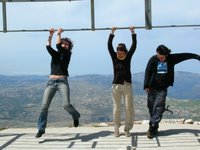
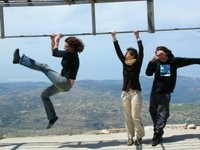
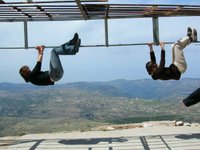
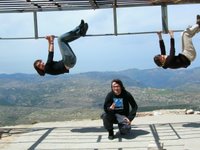
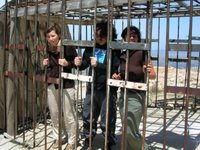
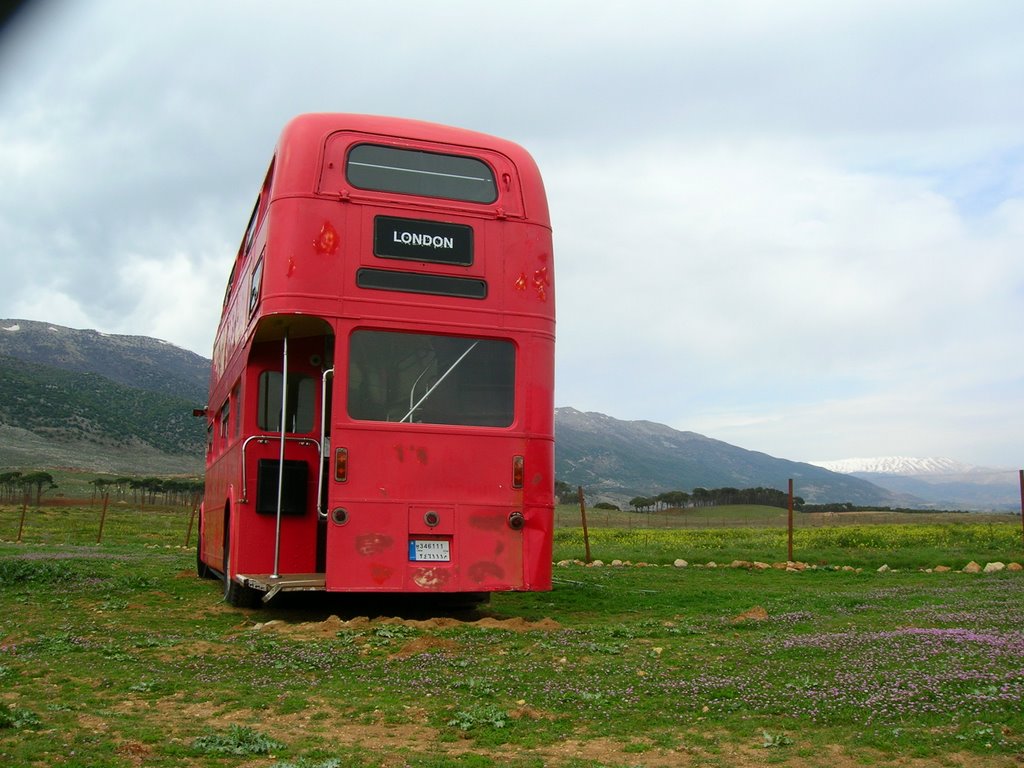
To top it all off, we had a picnic in the Bekaa valley (after manoevring the car through the last remaining bits of snow on the pass road) and found this really bizarre sight in the middle of nowhere!


Next, we tried to find the Chouf Cedar Reserve, which is quite high up in the mountains. We did see about three cedar trees (the first ones I've seen here!!) behind a fence, but somehow the 'reserve' appeared to be closed and we couldn't go in. So we just kept driving up the mountain until we got to the top, where the lack of oxygen or something made us really really silly. Check this developing photo story:

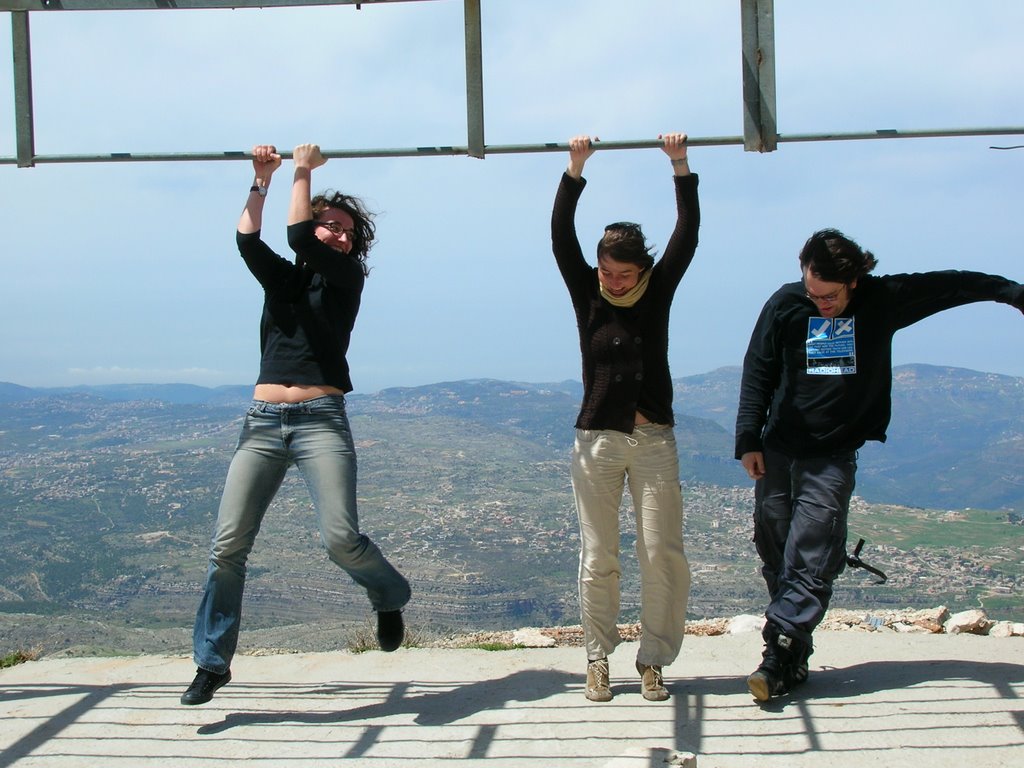


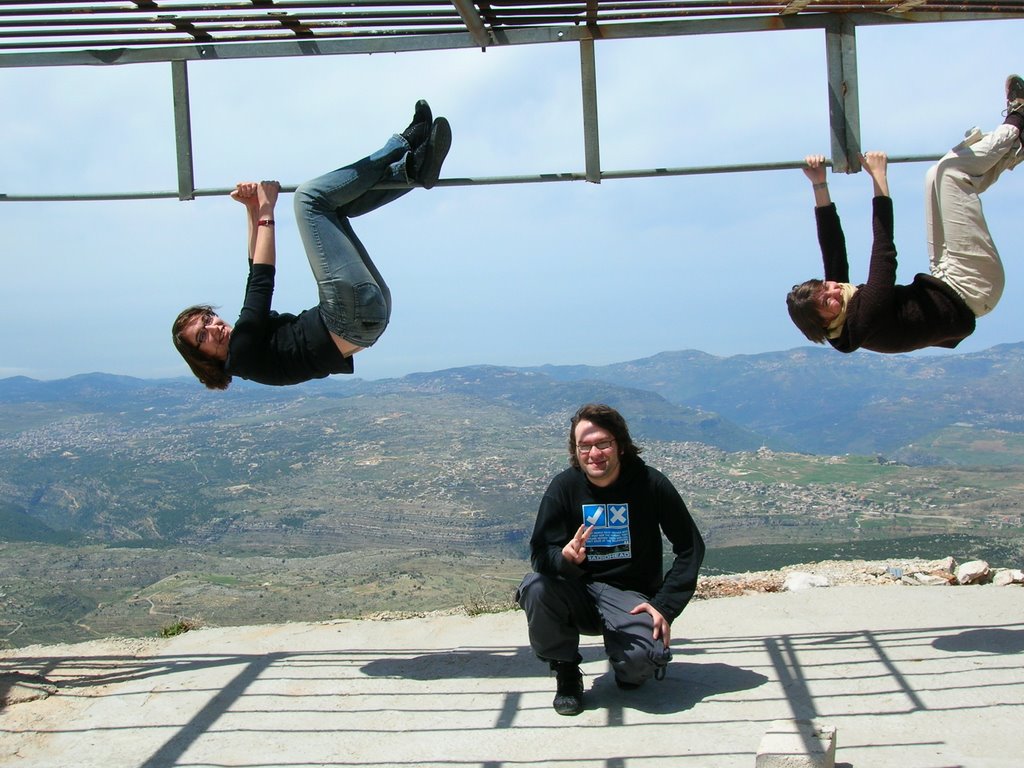

To top it all off, we had a picnic in the Bekaa valley (after manoevring the car through the last remaining bits of snow on the pass road) and found this really bizarre sight in the middle of nowhere!
Muriel was here
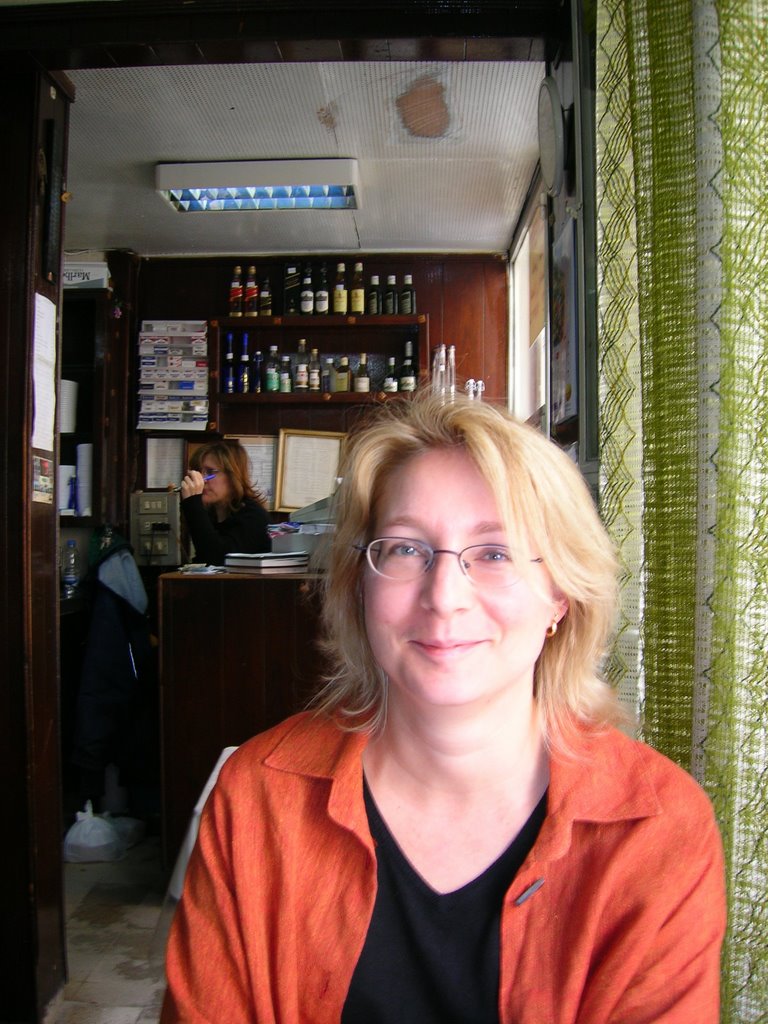
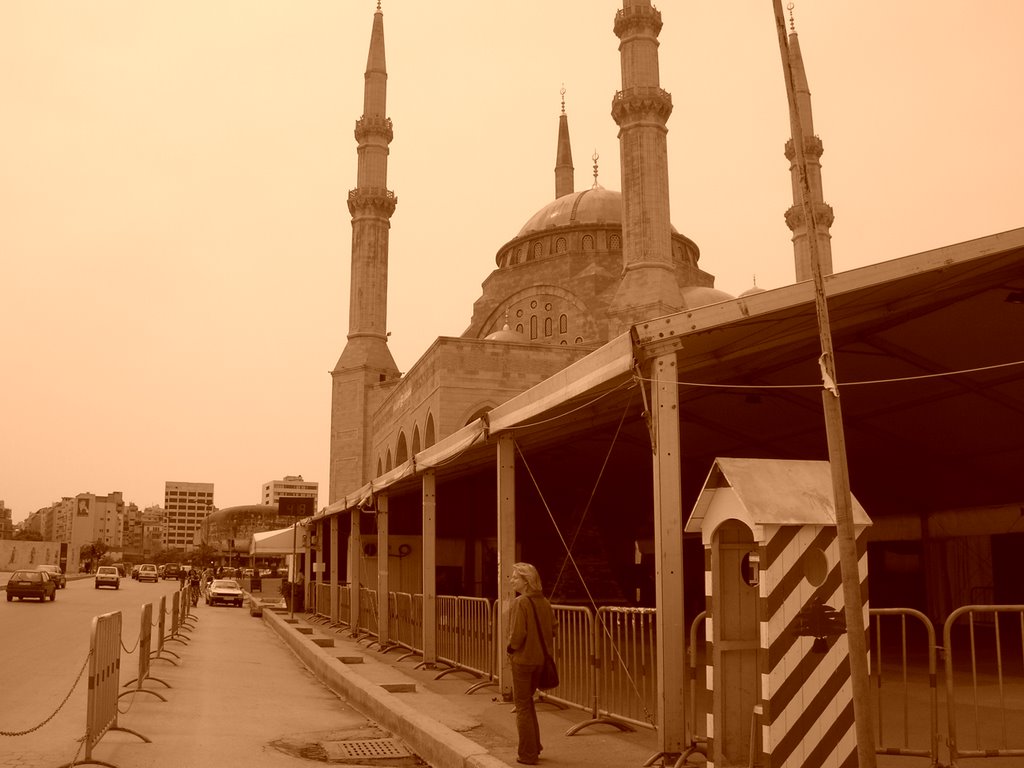
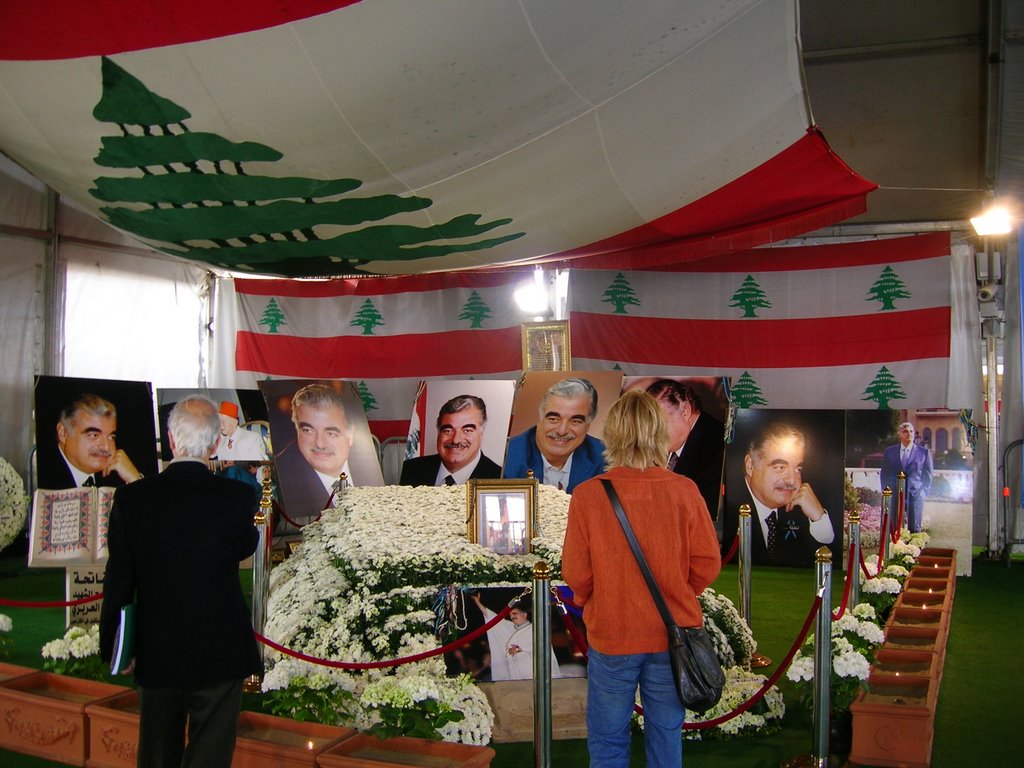
... for about 24hrs and we talked a LOT and ate yummy food - with a view of a guy with an outsize albino boa constrictor around his neck - and visited some major sites (Hariri's grave, Virgin Mega Store...) and smoked Argileh and it was great. I feel homesick. I want to go to Berlin.
Wednesday, April 05, 2006
Weird Story
OK, check this out. Very strange indeed. It's a story about information flow, in its various forms, and about life in this region. It happened yesterday.
My landlord - let's call him Elie; this is what living in a paranoid country does, by now I don't think it absurd that 'General Security', the not-very-secret secret police here might get bored and start doing blog searches for the term 'Beirut', and I don't want to pass them any real names - had been telling me that he'd been receiving phone calls for me on his mobile. In these calls, a guy with a strange accent ('like Gulf Arabic, you know what I mean', as Elie puts it in his own strange American accent - I am not good at covert action apparently, I am giving him away already!) had told him 'I have money for Eva'. Naturally, before he told me this, Elie had asked me inconspicuously if I happened to be waiting for any money shipments. Why give away any information without doing a bit of intelligence gathering first? You never know!
Anyway, so eventually I managed to obtain the number of this money-guy from my landlord. 'He's an Israeli', was his latest conspiracy theory about the mysterious caller. Never mind that you can't even travel to Lebanon with an Israeli stamp in your passport, let alone an actual Israeli identity. When I called, the pseudo-Israeli solved part of the mystery: the money he wanted to give me was money that the owner of my flat in the US owed me. Instead of wiring it and paying fees for it, he apparently preferred to send it through a trusted friend. No problem. Except that he could have told me before so that we could have skipped the whole Gulfie/Israeli part.
As the money guy - I still hadn't managed to find out his name - was a new arrival in Beirut, further fuelling the foreigner conspiracy, we agreed that I would come to the suburb where he was staying (New Jdeideh) and meet him in front of City Mall. So I spent about 45 minutes in a service (shared) taxi stuck in traffic and cruising through New Jdeideh, an apparently poor part of Beirut where the remains of civil war damage stand out much more prominent and ugly than in other parts, until I finally was told to get out in the middle of a roundabout and right in front of the new, shiny City Mall by the highway. A direct taxi would have taken about 15 minutes, but they do get quite expensive. Unfortunately I still had to cross the highway, which almost cost me my life, but hey what's new, this is normal in Beirut.
In front of City Hall, I had to call the guy again because he apparently forgot about our appointment (also a normal feature of life here). He said he would be right there and that his name was Hamid. I told him that I wear black-framed glasses - not too common here, unlike in Europe - so he'd recognise me, and sat down on a bench facing the entrance. One, two, three guys walked in through the glass door after being checked by the security guard, and all of them stared at me, presumably because I was staring at them, trying to figure out if they might be Hamid the money man.
Finally he arrives, a square-looking guy with glasses and a leather coat and a big friendly smile. He apologizes for the delay and pulls out his wallet to hand me the money in US dollars. By now I feel really tired and slightly irritated with the whole episode, if not at Hamid who is after all doing me and the flat-owner (almost wrote his real name...!) a favour. To be polite and despite feeling really tired and just wanting to get out of the blasted City Mall asap, I ask him where he is from - Iraq - and what he is doing here, is he visiting? Hamid looks at me slightly apologetically and points at his head. 'I am here for medical treatment. I live in Baghdad and a car bomb exploded next to me, and now I have some problems with my eyes.' My head feels really heavy and I feel a little bit betrayed by this sudden revelation - how could that just come out of nowhere?? Now I notice several auburn marks on his head and neck that look like scars. I feel like I should be doing or saying something appropriate, only I have no idea what that might be. 'I hope you'll be better now', is all I manage. Hamid smiles and says with a giggle, 'Insh'allah!'. That's a good one! 'Insh'allah', I reply, having learned that you can't really go wrong with that answer, and he shakes my hand with a firm grip like he would with one of his buddies, not like a man would with a woman (according to my own Middle East experience). And then he just vanishes through the glass doors, and I stay behind clutching the stupid dollars and feeling terrible, and wanting to run after him and make up for that terrible thing that happened to him! Instead, I walk into the next mall store, the Geant supermarket, and wander around slightly bewildered between giant aisles of imported French cheese.
Tuesday, March 28, 2006
Here comes Tekka
So 'Dots' was getting a bit too dotty, in my opinion. Instead I've decided to go 'boring'. What do y'all think?
It's good to catch up

and thank you too, c'etait vraiment genial de se revoir!!!
not to forget, of course, a huge thank-you for the best, the most beautful, the all-black all stars that have found their way to me by way of Anna's generously dragging them across half the globe to Lebanon...MERCI :)) (it's fun to be a brand addict, sometimes.)

Monday, March 13, 2006
Checking the scene with Anna in 48hrs
48hrs non-stop catching up, plus Beirut & Tripoli & Byblos!!!

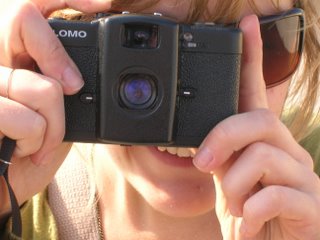
By the way, did you know Tripoli was actually famous for its pregnant squirrels of Phoenician times? They were so revered that they actually made statues of them. Bet your tourist guide wouldn't tell you that, huh!

Another interesting fact we discovered goes under the headline "Major Donors of the American University of Beirut":

Tuesday, February 21, 2006
Funding needed
Anybody have any ideas on how to get funding to go to this conference in Berlin, March 8-10?? I want to go!! I can't believe they're talking about this without me!! If I'm ever going to do a PhD it'll be on this topic, and the proposal I've written last fall is about this. Plus, of course I'd love to go to Berlin for a bit :).... please help if you have any ideas....!
Wednesday, February 15, 2006
Hariri & cartoon news...
Well, I didn't actually go to the demonstration marking the anniversary of Hariri's assassination. I didn't know why I should be going, or what exactly I should be associating myself with in this event: the demonstration as a celebration of Lebanese sovereignty or independence? No, thank you, I don't actually believe any longer that there is actually any positive development taking place that will strengthen Lebanese democracy and sovereignty. At least not one that I can make out. The demonstration as an opportunity for various groups to show their force and wave their flags? Yes, so I don't want to be part of it. The demonstration as a commemoration of Rafiq al-Hariri? Er, I don't feel I want to be part of the enormous personality cult that has sprung up around him, either. He may have been a good person and so on, but I'm not going to worship him personally.
Consequently, I stayed home and watched the event on TV, which was a little absurd considering that it is a mere 10-minute-walk from my house to Martyr's Square. But I don't have the kind of curiosity I had a few months ago when I came here. I am still curious, but in the meantime I've gotten to know how a few things work here when it comes to politics, and I am much more cautious now about what I want to be part of. I don't believe in the 'peaceful movement of all Lebanese for democracy and sovereignty' anymore. It doesn't really exist, in my opinion, even though that is what I wrote in my MA thesis only six months ago.
But there's no reason to give up just yet, there are tons of people who want to change the world and the way things work here. That's why I've, in the meantime, joined a small NGO called 'Nahwa al-Mouwatiniya' or 'Towards Citizenship'. It's a group of about ten people from very different backgrounds who want to make Lebanon a country that respects its citizens as such, regardless of their religious/communal background. Actually, I should go now because we have a meeting later..
By the way, if anyone is interested in reading more stuff about the Cartoon issues & discussing it, here is an article by Robert Fisk, kindly provided by my friend Leah. And there's also an interesting article and discussion on this topic by Fred Halliday and others on Open Democracy.
Wednesday, February 08, 2006
The Wild West and the Fanatics
So yesterday I passed by the Danish consulate while in a taxi. I was kind of unprepared for this and hadn't been thinking about what happened on Sunday - 'normal' everyday life picks up very quickly here after bombs, demonstrations or whatever and provides a nice shield against thinking about this stuff. So all of a sudden I looked out the car window and found myself surveying a very familiar scene: hey I've seen this on TV the other day.....OH! Ok, it's the Danish consulate... a completely burned-out shell now. At least it looks like that - they say the damage is actually not that bad. One guy died in there. He was only 22. He got trapped by the fire that he and his buddies had been setting, and jumped out a third-floor window to escape. He didn't make it. Why why why??? Why wasn't he playing a football match with his team, or taking a walk with his girlfriend or something, or drawing, or...? How did he end up in there?
As has been suggested a lot in recent days, I think the whole problem is obviously an outgrowth of the 'Islam vs. the West' issue. This is the answer to the 'war on terror': just as this supposed war has no objectives that can realistically be achieved and is directed against an ill-defined, general 'enemy', the 'war on caricatures' has no specific goals either. It's an outburst of anger and frustration directed at an enemy perceived as all-powerful and overbearing. The comparison is lacking though in that the violence related to the caricatures is largely spontaneous I think and not necessarily related to a sustained anti-Western conspiracy. It's not really a policy, and it shouldn't be confused with the policies of many moderate Islamic parties. An interesting article on this topic is here.
What can be done about this? In my opinion there are many things we can do. Even if Muslims take to the streets in London and hold placards saying 'kill all non-believers'. Even if occasionally various al-Qaeda people appear on television and tell us we're all going to die and we're on the wrong path. In Europe, we can
1) start to question our assumptions about Islam, Islamic countries, Arab countries - are we perhaps mixing up different things and notions here that should be kept separate? Are we making too many assumptions about what life is like 'over there'? Can we somehow make attempts to find out (read stuff, talk to people)?
2) look at what our governments are doing in the 'war on terror'. Is all of it a good idea? Do we need all of that, or some of that? Especially in the UK, but also in other countries (Sarkozy in France) including Denmark - how is the Danish government treating its immigrants? How have Danish immigration policies changed over the past few years? Do some of these policies make things worse in the way a self-fulfilling prophecy can?
3) say something if we disagree with any of the above policies.
4) not take personally the insults and outrageously prejudiced ramblings of a minority of deluded people (i.e. 'terrorists') in those infamous Al Jazeera tapes that crop up periodically ('The West is immoral' etc.). They probably have no idea what they're talking about anyway.
In Arab countries, we (the people who live there and the foreigners who work there) can also do a lot of things:
1) take a cue from the freedom of expression debate that is currently going on and see if there's anything we can do to protect it in Arab countries.
2) make sure that people have alternatives to joining radical religious movements. And this, of course, requires an enormous amount of change: more economic opportunities. More ways for citizens to ask for their legitimate rights (freedom of religion, expression, association...) without endangering themselves or their families. A foreign policy on the part of the international community that does not reward the wrong people (i.e. autocratic, backward-looking governments).
3) question our prejudices about the 'West': what are our assumptions about 'life over there'? Should we trust what our media says? How can we use the opportunities we have (internet etc.) to obtain different information? (i.e., read stuff, talk to people).
4) even if they are limited: grasp every opportunity to speak out against the government if we disagree with them. They might not be as powerful as they have been in the past...
Well there you have it, this is my insignificant opinion on what's going on. I would even go so far as saying that this is something we HAVE to do if we want to stop and eventually reverse the current trend of misunderstanding, fear and frustration.
Monday, February 06, 2006
Violent Sunday
Ok, never mind DSL. Right now everybody is more worried about inter-communal violence making a real comeback onto the stage here. I wasn't here yesterday to witness what was going on, and I feel fortunate! I spent the day in Saida (Sidon) in the South of Lebanon and only came back in the evening to find that the crossroads close to my house looked like a battlezone with hundreds of soldiers at military checkpoints stopping each and every car. Lots of protesters from Christian parties (the Lebanese Forces and General Aoun's party) where marching towards the church that had been ransacked by protesters during the day (nobody holding them back...). It was all a bit much to take in. It got worse though when I turned on the TV and saw that while I had been blissfully exploring the souqs and sea castle of Saida and eating a delicious meal in a seaside cafe, there had been a major street fight going on at a crossroads that is literally a few minutes away from my doorstep. On CNN, Al Arabiya and Al Jazeera, I could see the street corner that I round about twice on any given day and which up until now had always struck me as a completely oblivious, non-descript, run-of-the mill street corner. So much the weirder to see this area transformed into a war zone with stone throwing, tear gassing and water cannon use in full force. Also, the church that was attacked by protesters is on my regular jogging route. I feel a little disturbed by how close-by these things are, although today everything seems relatively calm. At least on the surface: underneath it, the police and security forces are conducting a massive wave of arrests among Islamist activists of all couleurs. Ok, they obviously have to do something, but if they suspected these people of criminal activities beforehand, why didn't they arrest them earlier? And is this really going to help or just breed more resentment of - perhaps innocently arrested - people against the state and the system which is going to flare up later?
Speaking of the infamous system, I think it's fairly scary that despite the heavy police and military presence (when we left Beirut early in the morning, the streets were already packed with army and riot police) public order could not be maintained. This underscores another and more dramatic absence of system when it comes to maintaining the peace - which makes DSL and electricity problems look temporarily petty. If the army is afraid of getting involved in this fight because it would have to take sides and this might have dire consequences for the peace between the different communities, then this says a lot about the weakness of the central government. Clearly, the army and police are not considered 'neutral' instruments fit for ensuring the protection of private property or the prevention of violence directed at citizens (which fortunately hasn't occured so far). The interior minister resigned today because he officially did not agree with the use of water cannons against violent protesters (and they were really violent). A lot of people are scared about what all of this might mean. Politicians, meanwhile, call for 'dialogue' without ever making any concrete suggestions as to how this crisis might actually be resolved. Religious leaders take the lead in calling for peace and calm, and Mosques are broadcasting calls for people to take it easy and not get involved in violence. Surely that doesn't bode well for a secular state power to step in and resolve things - and this would be badly needed I think. Not just to control violence & ensure 'law & order' but also, for example, to give citizens who disagree with all this stuff a space to hold their own, peaceful protests and express their opinions. This is impossible right now. People are too scared!
While all of this was going on, I spent part of the day in a meeting with supporters of various Islamic charitable NGOs who are affiliated with the Muslim Brotherhood. A friend of mine had accepted to hold a workshop for them about recruiting volunteers. Behind this technical topic, there were a lot of discussions about values and social and political issues going on. I was only there for part of it - warmly welcomed by everyone present - and couldn't understand all of it, but my friend says the discussions were extremely fruitful. For one, the fifteen people who came to the training were fifteen people less at the demonstrations in Beirut. And secondly, during the discussions people really opened up to a lot of ideas they hadn't considered before. Say, for example, the 'profile' that a possible volunteer should have. Some in the group wanted to enforce gender restrictions here - and pointing out to them that Lebanon has signed and ratified all major human rights conventions and that gender discrimination is therefore in breach of national and international law was a new idea that people were willing to consider. And there are many more examples. As a next step my friend wants to get this group together with quite a hard-line Christian one to debate. Inshallah this will happen! It would be great, especially at this time.
Ok and finally, here are some unrelated pics from my Saida-excursion...


So yeah it was a windy day! Here my friend Hania and I climbed to the top of this holy Mary-statue. Apparently Jesus at one point was passing through Saida (behind me in the picture, with the huge Ain el Helweh camp for Palestinian refugees in the foreground - this camp cannot be entered by the Lebanese army, it's controlled by Palestinian forces. From up there it looks like where Sidon has maybe 1 person for every 2 square meters, Ain el Helweh has 5 persons per sqm.) and Mary, like a good mummy, waited for him at the top of this hill. Hence the statue is called Holy Mary of the Waiting, or something to that effect. Nice view, in any case.
Friday, February 03, 2006
DSL exasperation
So finally DSL was supposed to arrive in Lebanon and save a lot of people (including me) a lot of frustration created by painfully slow internet connections. Introducing DSL has been talked about in Lebanon for the past few years, but recently the government stepped up the ante by actually naming a date for this endeavour, March 2006. Well, let's see. What is happening: yes, DSL will arrive in Lebanon. However, this will not bring the promised improvement in internet enjoyment for the population at large. Initially (that is, for the duration of the next six months), only 360 internet users will have the privilege of using DSL connections. Three-six-zero. This is called a 'pilot phase'.
The government maintains that this has something to do with a bottleneck in access to the international cable that is necessary for DSL use, and that they're working on 'augmenting capacity'. Not only does this sound like they're firmly stuck in the oil pipeline age and conjures up images of workers in protective clothing and with heavy tools working on those pipes that carry a fluid called 'information', it also seems to be a plain lie according to people who work in the telecoms sector and who talk to newspapers about this. They say that due to the delay in introducing reasonably fast connections to Lebanon (which already function in most neighbouring countries: Lebanon is really lagging behind here even if we leave aside the fact that there are of course a lot of people here who don't even have electricity or are able to read anything on the internet, being illiterate), a lucrative market has been created for wireless access. There are a bunch of wireless providers here who can give you fast access at the hefty rate of about $50 a month. And these people don't like the idea of competition, so they lobby the government to slow it down....presumably providing them with enough time to hedge their bets and become involved in the DSL business too. Whatever the case, the government is certainly happy to comply with their wishes, because high DSL rates - initially monthly rates will come up to, uh, let's see....$50/month... (btw about twice as high as in Jordan) - mean higher revenues for the state treasury. And they need the money.
Is anybody up for intiating a world-wide letter writing campaign that would convey to Lebanese government and business how see-through their corruption really is and how badly they need to stop it if they want to be credible....?
Monday, January 30, 2006
Baalbek
Below are some pictures of the Roman ruins in Baalbek in the Bekaa valley. I visited them last week with my Argentinian friends Pablo, Leo and Martin after we had been partying, so we spent the day stumbling around the ruins with a major hangover. Very nice though and very impressive, this leaves behind anything in the way of Roman ruins that I've seen in Europe. The temples are massive and amazingly well-preserved.


Who knows.... anyway, the fact is that today, Baalbek is an area whose inhabitants support Hizballah, and outside the temple ruins there are some stands selling touristy stuff, like Hizballah T-Shirts and flags. It is located in the Bekaa valley, which is not really a valley but more like a plain between the two mountain chains that run from North to South in Lebanon.


Another thing this made me think of is the whole female Goddess worship thing. Baalbek was obviously dedicated to different Gods and stuff, and the largest temple there - the columns in the picture above are some remnants of it, and according to my guidebook are the largest man-made columns in the world - was Jupiter's. But the most interesting temple was dedicated to Ishtar or Astarte or whatever her name was, the chick who was made so famous in the 'Da Vinci Code' by Dan Brown. Of course he's making a lot of money plagiarising not only a two thousand year old-cult but also another book, which I happened to come across in the flat I am renting. Has anybody ever read 'Skinny legs and all' by Tom Robbins? It was published in 1990 and contains essentially the same 'revolutionary' idea that Dan Brown is using (that religion was really all about worshipping women until a bunch of frustrated, mysoginist priests turned up in the Holy Land, turned things around and wrote a best-selling book about it called the Bible, which is largely responsible for the rampant patriarchism and macho chauvinism inherent in a lot of world cultures today), only in a less ready-made-for-Hollywood, weirder and more fun way. In 'Skinny legs' it's not a bachelor scientist who looks like 'Harrison Ford' and thinks politically correct feminist thoughts while still having a pretty French woman around to look out for and protect (red cliche alert...), but a bean can, a dirty sock and a spoon who discover the true nature of Astarte-worship and the whole religious conspiracy that has ensured male domination of the religious and social order to this day. (By the way, 'The Da Vinci Code' is officially banned in Lebanon.) If I were Tom Robbins I would definitely sue Dan Brown for some of that easy money he made with his clever book. I have a feeling though that Tom Robbins might spend a lot of his time consuming various drugs if his wild imagination is anything to go by...so maybe he's not up for suing...a shame!!!
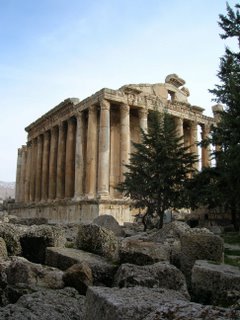


Who knows.... anyway, the fact is that today, Baalbek is an area whose inhabitants support Hizballah, and outside the temple ruins there are some stands selling touristy stuff, like Hizballah T-Shirts and flags. It is located in the Bekaa valley, which is not really a valley but more like a plain between the two mountain chains that run from North to South in Lebanon.

Tuesday, January 17, 2006
Has anybody seen the system around?
Since I haven't gone on any touristy trips or witnessed anything that could qualify as exciting and worth telling you about, let me tell you about the absence of a system in Lebanon. I know it might sound strange at first, but I've been thinking about this for a while because I encounter the lack of system constantly, everywhere. Obviously here at work, I think I have talked about this in a previous post, but that's a different story. What I'm referring to is the absence of a central state in Lebanon.
It's something that you read about a lot when you study political science, different theories of the state etc., states in the Middle East.....and invariably, you will get to the universally accepted contention that there is an absence of central state power in Lebanon. Ok, it seems fairly obvious, there was a civil war, several militias that were involved in the war still retain their arms, the government doesn't have control over all of its territory: yeah, makes sense that you can't talk about much of a central government power. But this is only such a small part of the story!! And any political scientist looking at Lebanon from this angle is going to miss out on so many things. (I really want to send my thesis supervisor "Tommy" at FU Berlin an email and tell him about all of this, ask to retract my thesis and add some very important points - don't think they'll be up for it, but it would be great).
Normally, 'the system', i.e. some kind of centralised government, should formulate a bunch of policies, like social or economic policy. At least if you claim to be a democratic state, which Lebanon technically does (although of course I haven't met any real life Lebanese yet who think they live in a democratic state). It's a republic, you have elections, representation, separation of powers, the whole lot. What you don't have is economic or social policy. Why? Because money and power are allocated along sectarian lines: each of the different confessional communities, and of the big families within these communities, wants to make sure they get their share of the dough and the power. And they are strong enough to make sure that this works.
Some examples: jobs within the state administration in Lebanon aren't filled according to merit - i.e. who does the job best - but mostly according to religious and sectarian background. This is something that almost any standard text on Lebanon will tell you. Until very recently, I thought this meant that every ministry has its share of Christians, Sunni and Shia Muslims from different sects (there are 18 recognised ones in Lebanon!!). But, no! This can also mean that any one ministry is completely dominated by one single religion or sect. E.g.: the ministry of social affairs is mostly staffed with Shia administrators. So, what happens when you appoint a Christian minister to the top of this structure?? That's right, nothing. Nothing controversial can happen because that would risk an open conflict between sects, and you don't want to do that! Especially not right now, when there's a general and quite serious government crisis which pits the five Shia ministers in the government against their Christian and Sunni counterparts. (If you appointed a Shia, all the money would go to the Shia community.) So, Lebanon will go on without the social policies that would be so badly needed, like a general health insurance system (absent) or a sustainable pension system (absent) or a reform of the education system (badly needed, even though it might be one of the better ones in the MidEast). Instead, a network of charities and associations provide some basic services, and they, of course, are sectarian in turn. To create a state policy and structure to replace this network of sectarian, civil-society providers of social services would be great, but seems to remain pretty utopian. It would require a lot of money and would step on a lot of peoples' toes....
Or, take economic policy - opening up the telecommunications sector. Lebanon's mobile phone rates are some of the highest in the world. It's incredibly expensive - especially if you put it in context - and dominated by two companies who have special arrangements with the state. This makes the whole market very uncompetitive, but: you can't open it up because the Lebanese state depends on the income! They rely on people to use their mobile phones and pay these high rates as a major source of state income. This is especially needed considering Lebanon's enormous public debt caused mostly by overspending on reconstruction projects: it's actually the highest ratio of public debt to GDP in the world, at 171%. This is amazing! The public debt is almost twice as high as what the entire Lebanese economy generates in a year. Now, if you had a system, and a state power that were strong enough to make people pay their taxes, you might not have to rely so much on people's mobile phone habits. But there isn't any power that could make sure taxes are paid, and a budget gets agreed upon in time, and that the loans Lebanon gets are actually used for reducing public debt in the long term.
And there are so many more examples -- the absence of traffic rules. The inability to ensure even the most basic measures of environmental protection. The absence of central heating, or electricity when it's raining...I blame all of that on the system, or more precisely on its absence.
At first sight, it might not seem so bad that money gets allocated to different sects - as long as they all cooperate and care for their respective constituents, what's the problem...? I guess the problem is, as I was trying to argue in these examples, that for some things you really need a system, i.e. a state that can take care of some stuff from the center. Otherwise you'll always be at the mercy of any minor query between different sects, which could ignite at any time and paralyse everything. Plus, it makes everyone reliant on their respective community. There isn't any public space for people to demand their rights as citizens; everything has to go through your sect/community. So don't believe those people waving Lebanese flags and claiming to be patriotic: that is largely an expression of opposition to Syria. But it's very far away from being patriotic about a state....because it doesn't exist!!
So I have to disagree with a friend of mine who says that the Lebanese are experts at opposing any kind of system. It's more like: they don't have a system that they could oppose in the first place, really. And I think this problem has been here the whole time and will resurface more and more now that the Syrians are gone from Lebanon, taking with them their imposed and repressive security system and any excuse for the Lebanese to blame everything on Syria. Anyway, all I can say is that I have hugely underestimated this problem, looking at it from outside. Reading about things and seeing them first-hand really are two different things - I know this sounds really very naive but hey, it's the way I feel about being here.
And if you take this further and think about how to solve the problems that arise from not having a system....it really goes back to a lot of fundamental questions, like, how can the different sects cooperate? What is the role of outside actors in this? You could go on forever.
Monday, January 09, 2006
A River Called Tripoli
For any of you who thought the town of Tripoli was a coastal town in the North of Lebanon, I have some news: on my sightseeing trip there yesterday, I discovered that it's actually a river! :)


 I still had fun though because Tripoli has a lot of souks and looks a bit like Damascus or Aleppo - very different from East Beirut. Somehow, I was relieved to discover this and to know that there actually are Muslim communities in Lebanon; something that is easily forgotten when you live and work in a Christian neighbourhood, like I do. Getting lost in the network of souks is a lot of fun, and like in Damascus there are different sections: a clothes section, a fruit and veggie section, a meat section, a jewelry section, and of course, a tacky-crap-section! After I spent some time in the clothes section unsuccessfully looking for a pair of rubber boots and warm socks because my shoes were seriously soaked after crossing the above river-street, I settled for a pair of stuffed-animal slippers in the shape of lions from the tacky-crap-section, because at least that way my feet would be warm once I got home. This proved to be a good calculation and I cannot describe my joy at wearing the brand new lion slippers after a day of slushing through muddy water in trainers! Luckily there is so much to distract the senses in the souks that I didn't notice it so much. There are tons of little Madrassas with black and white stonework, and Khans (storage rooms) from several centuries ago, and incense and tea and the sweets that Tripoli is famous for....I bought some from an old man in a little shop - they're the best. And of course there's the castle, which I will have to visit next time since it's basically a lot of ruins under the sky and I wasn't up for that in the rain. Anyway I'm definitely going back, it's a really nice day trip.


 I still had fun though because Tripoli has a lot of souks and looks a bit like Damascus or Aleppo - very different from East Beirut. Somehow, I was relieved to discover this and to know that there actually are Muslim communities in Lebanon; something that is easily forgotten when you live and work in a Christian neighbourhood, like I do. Getting lost in the network of souks is a lot of fun, and like in Damascus there are different sections: a clothes section, a fruit and veggie section, a meat section, a jewelry section, and of course, a tacky-crap-section! After I spent some time in the clothes section unsuccessfully looking for a pair of rubber boots and warm socks because my shoes were seriously soaked after crossing the above river-street, I settled for a pair of stuffed-animal slippers in the shape of lions from the tacky-crap-section, because at least that way my feet would be warm once I got home. This proved to be a good calculation and I cannot describe my joy at wearing the brand new lion slippers after a day of slushing through muddy water in trainers! Luckily there is so much to distract the senses in the souks that I didn't notice it so much. There are tons of little Madrassas with black and white stonework, and Khans (storage rooms) from several centuries ago, and incense and tea and the sweets that Tripoli is famous for....I bought some from an old man in a little shop - they're the best. And of course there's the castle, which I will have to visit next time since it's basically a lot of ruins under the sky and I wasn't up for that in the rain. Anyway I'm definitely going back, it's a really nice day trip.
Monday, January 02, 2006
Happy New Year
A very happy, healthy, successful, exciting 2006 to all of you!!
The Holidays here have been really nice, I went to a really nice Christmas dinner with a bunch of strangers that I'd met recently, and it was really good fun. Almost felt like Erasmus, with two Jordanians, a Swiss girl, an Italian, two Germans and an Armenian there.
The new year's party I went to had been organised by somebody I met through work, a guy who works at the World Bank here, and some of his friends. They are all consultants, work in banks and come across as very serious people - but of course, being Lebanese, they know how to party!! So my friend Sherine came to pick me up wearing a bright red, curly wig, whereas the last time I'd seen her was on a panel at the conference we'd organised a few weeks ago. And all the other economists at the party soon were very drunk and started wearing funny party hats and all of that. Later on I drove to a different club with a few friends, six of us in the car piled on top of each other, nobody sober and the car going really fast...a good thing, in that case, that nobody is serious about traffic controls here. Anyway, unfortunately I always forget to take my camera when I go out, so I have no pics...
Had to spend the past two days in bed because I already had a cold before all these parties started - after New Year's I unfortunately could no longer talk, my voice was completely gone. It's coming back now... Luckily they gave us today off at work, very nice, and it's a beautiful sunny day with 20-something degrees, lovely!
On Friday I was feeling slightly more convinced about my work for the first time. After the Ehden workshop experience I talked about last time, and after meeting all these people who talk about ending feudalism and interconfessional dialogue but essentially are completely racist and locked up in their own communities..... we are now applying for a new project. The whole office got together and discussed several ideas - the overall theme was 'youth and political participation' - and in the end my plan was chosen!! To be honest it was easy because none of the other people really felt like writing a project proposal until Friday, but still, I felt a bit chuffed about it. So now we want to try and get young people from different regions together and train them in facilitation and moderation methods so they can go back and pass on this knowledge - at least giving people the tools to cross confessional and regional boundaries, should they want to. Whether or not they do it is of course still up to them. But first we have to write the proposal and get the project working of course. I will keep posting in 2006, of course! :)
Subscribe to:
Posts (Atom)

